I’ve been back in the writing world for three years and seven months being part of a local writers’ group that meets monthly and has critique groups that I have participated in, and an annual writers’ conference. I’ve also attended two writers’ luncheons, put together my own little group of writers who meet weekly, and in the past two years have been involved in an online writers’ group as well as being involved in a critique group for the past two years that meets every other week. I have also been reading books on the writing craft.
During the past two years, I have been researching and exploring the publishing possibilities, and I have found, as the title of this post suggests, that there is a Great Debate among writers: to publish traditionally or indie (self) publishing.
I have found that many older people are quite adamant about traditional publishing but when asked why can’t really give me a satisfactory answer. I have also found that many writers who have already published books seem adamant about starting with a traditional published. However, I have also heard some of these already published writers talking about their desire to switch to indie publishing. (For the sake of simplicity in the rest of this blog post, I will only refer to traditional and “indie” publishing because, though “indie” and “self” publishing are quite similar, “indie” publishing is publishing completely on your own and most of these writers are determined to put out their best writing, whereas “self” publishing includes the writers who just want to put out their writing as quickly as possible and don’t spend enough time on edits, as well as those who publish through vanity publishers (these are publishers who allow you to keep all of your rights and maintain all decision making, but you pay them a fee to help you publish and do some marketing). “Indie” writers/publishers have a better reputation than “self” published writers.
I have found it quite confusing to speak with published writers about the publishing options because they stand firm in telling me that I should seek an agent and go the traditional publishing route first. But, when I ask why, they offer no real good, solid reasons.
I even know of a writer who insists on the traditional route, but after trying that route for a few years, and even gaining an agent, is preparing to self publish the book through a small publisher, which is what the agent found for this writer. To which my question is: will this writer still have to pay the agent for this?
Okay, so here’s what I have learned about traditional publishing: the first step is to acquire an agent who will most likely have you make lots of changes, and, possibly, rewrite your entire manuscript. Then the agent will help you find a possible publisher, who may require you to make more changes and, possibly, rewrite your entire manuscript yet again, and even change it for a different target audience, and then, that publisher may or may not actually publish your manuscript. The entire process can take two to four years for your manuscript to get published, maybe even longer, if ever. If you are blessed enough to get the manuscript published, first of all, it may not be the story you originally intended in the first place. Secondly, your agent and the publisher get a cut of your sales, and you will be extremely blessed to receive even 10% of your sales. Also, you will be required to do as much of your own marketing as possible, which used to be the traditional publisher’s job. Finally, if your first book is part of a series, depending on the sales of the first book, the rest of the series may never get published, and if it does, traditional publishers stop publishing and remove your book from the market after just four years.
Now, here’s what I’ve learned about indie publishing. Yes, you must do ALL of the work yourself. You write the manuscript, AND, if you’re devoted and committed to doing the absolute best work you can do, you will have it critiqued; you will make appropriate changes based on those critiques; you will self-edit and do several rewrites; you will hire a professional editor to give you feedback and then rewrite yet again; you will have beta readers (if you don’t know what beta readers are, read this post), then you may make changes again. Then you will finally publish it through an indie publishing venue like Amazon’s “Create Space” or “Book Baby” or one of the other indie publishing outlets. While you are still working on your manuscript, you may want to begin to think about building a group of followers who would be interested in reading your writing. A good way to do this is to start a blog and share things about your writing and about yourself, as well as becoming active in other social media such as Facebook, Twitter, Goodreads, Instagram, etc. When your book is published, it’s a good idea to do a Book Launch (next Monday’s post will be about Book Launches). You will also want to put the information out on your social media, do book signings and/or speaking engagements. Get creative about how and where you can promote your book, but don’t over-saturate your social media or you will turn people off because they will think the only reason you’re on social media is to promote yourself and your writing. Your readers want you to be real and to care about them.
Another thing I want to share with you here is some interesting information one of my writing friends recently shared with me on this subject:
One of my other writing friends has also been researching these options and questioning other writers about their opinions. She shared with me that she recently spoke with some writers who have had books published through traditional publishers and tell newbie writers that they should go the traditional publishing route. She began to ask them: “How did you find an agent or publisher?” She said that most of them said that they found their agent or publisher through a friend. What she realized is that all of these already published writers are telling newbie writers to go the traditional publishing route, but they aren’t offering to introduce you to an agent or publisher. They don’t even tell you that they found their agent or publisher through a friend unless you specifically ask that question. Her thought is “so these already published writers are telling all of us newbies to go the traditional route while they are trying the indie route, like they want us to try the traditional route while they flood the indie market with their works.”
I apologize for such a lengthy post, but I hope you have found it informative and that it gives you something to think about and consider in your own writing journey. If you have any thoughts or questions, please leave them in the comments section and I’ll do my best to answer or point you to where you can find the answer.

I attended the Lancaster Christian Writers Super Saturday one-day writers’ conference on Saturday, April 8, 2017. It was so much fun because the speakers and seminars were extremely helpful and informative and because I was able to connect with some old friends and make a couple of new ones.
It’s always fun to connect with other writers because they understand me. They think like me. It’s great to be able to share challenges and successes and to be able to support and encourage each other.
I know I’ve said this before, but if you’re a writer and you haven’t been to a writers’ conference, you really should go. I’m sure you would enjoy it. I know most writers are introverts (including me), but you know, even we introverts need to step out of our comfort zones once in a while, and I don’t think there’s any place better to do that than with other writers because you’re guaranteed to have a common topic of conversation.
Here are some highlights from the day:
My dear friend, Mike Dellosso, author of Centralia and Kill Devil, was the keynote speaker. (I’ve posted a couple of book reviews of some of Mike’s books here in the past. I’ve done an author interview with him as well and included some of his books on several of the Top Ten Tuesday posts I’ve done in the past.)
Mike was the first published author I ever connected with in public in regard to writing and he has been a great help and encouragement to me, and I can always count on him to give it to me straight. Last year he looked over a few pages of my WIP and informed me that it was “lifeless”. Yes, he said that, but then he said, “I’m sorry, that sounded harsh.” And he followed that up with suggestions and explanation of how to fix the problem.
Anyway, his keynote this year was very good and inspirational. One quote that sticks with me: “Wherever you are on the road in your writing, that’s where God wants you at this time. Do your best.”
I also attended two seminars presented by Roseanna White, author of Lady Unrivaled. She presented a seminar on “Fiction Rules and When to Break Them” — one example: “Show Vs. Tell”: The Rule: Do this as much as possible because it may take longer and consist of more words, but it makes the story vivid. Her second seminar taught what’s important in a book cover and how to be sure the cover of your book is both professional and eye-catching, as well as the fact that it should evoke emotions, questions, or interest, and convey something important about the book.
Laurie Edwards was a fun speaker. She did a seminar about “Adding Emotion to the Page: Surefire Techniques to Connect with Readers” as well as a seminar about “Information Dump or Dramatic Flashback? Using Back Story the Right Way”. She had us do some very intriguing exercises in each seminar that really drove her points home. She told us a story about a conversation she had with someone who asked what she did for a living, to which she answered that she is a writer. The other person asked a few more questions, one of which Laurie answered with, “My characters talk to me.” After a pause, the person she was speaking to said, “They don’t really, do they?” We all laughed. Non-writers just don’t understand those of us who write. 🙂
There were also seminars on marketing, social media, organizing your WIP for effectiveness, and how to turn your life into award-winning fiction. I was not able to attend any of these seminars.
At these conferences, several seminars run at the same time and you have to choose the ones you believe will be most helpful to you where you are currently at in your writing. However, I did pick up a book about marketing and one about social media. I can always read and study on my own. I actually do this a lot. There’s something to be said for being “self-taught”. Some of the most successful people in history were “self-taught”.
Have you ever been to a writers’ conference? What was your favorite thing about it?

Reading and Writing are my two most favorite things to do. I spend as much time as I possibly can doing these two activities, which as long as we have child(ren) still living in our home, is not as much as I would like, but the fact that I have lots of friends who love to read and write as much as I do is a huge plus. It allows me to share with other like-minded people, which is great, because even my husband doesn’t really understand my artist/writing ways. 🙂
Reading and writing go hand-in-hand. To be a good writer, it is imperative to do a lot of reading, and not just books on the writing craft. Actually, sometimes you can learn more about writing from reading a fiction or nonfiction book than from some of the books on writing.
I’ve been told that I must spend a lot of time reading the type of books that I want to write because that’s extremely helpful. However, I love so many different genres that I read from a wide spectrum, which I think is also extremely helpful in many ways.
Since reading and writing are solitary activities, it’s important to be purposeful about getting out and spending some time with people. After all, that’s one place a lot of story ideas come from. Also, to just spend time with other reader/writer people helps to feed our creativity and helps us to be encouraged because, let’s face it, writing is hard work!
If you visit my blog regularly, then you’ve probably seen many of my Monday posts that are reviews of books I have read, so you know that I read a wide variety of genres and stuff that’s been published recently as well as many years ago.
What about you? What do you like to read?

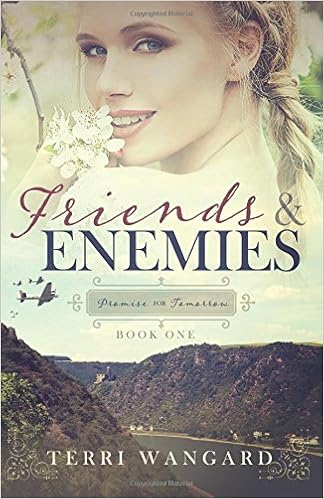
Friends and Enemies is the first book in the Promise for Tomorrow series by Terri Wangard.
The story begins in 1943 and moves through 1944 and touches a bit of 1945. Heidi Wetzel lives in war-torn Germany. She moves to a rural farm to help care for evacuated children and has never been a supporter of National Socialism. She takes pleasure in passive resistance, but must exercise caution around neighbors who delight in reporting to the Gestapo.
Cadet Paul Braedel trains for the U.S. Army Air Force. As a navigator, he is sent to England with a crew that will fly a B-17.
Both Heidi and Paul experience loss during this difficult time in world history. Then Paul finds himself alone in Germany and he hears a gentle whisper, “Find Heidi”. Heidi had lived in America during her high school days and had known Paul during that time, but now he’s an enemy. How much will she risk to help him?
This story drew me in right from the beginning. I love history, especially when it is woven together with wonderful fictional characters. That brings history to life and implants it in my brain much deeper and stronger than any dry history textbook ever has. Friends and Enemies is a 527 page book, but it kept me turning pages and in just one week, I completed reading it.
I came to care deeply about both Heidi and Paul throughout the story and I felt their fears, shared their laughter and their tears in the experiences of life during war; war that touches every aspect of your life. Heidi and Paul will live in my memory for a long time.
Friends and Enemies was very well written and though war can never be without violence, pain and sorrow, Terri Wangard did an excellent job keeping the violence to a bare minimum. The story also taught lessons about what it’s like to live with war right in your own backyard.
I look forward to reading No Neutral Ground (Book Two) and Soar Like Eagles (Book Three) in the series.
If you enjoy reading historical fiction, I encourage you to pick up Friends and Enemies by Terri Wangard. You won’t be disappointed.
I read The Shack by William P. Young in 2008, not long after it came out. Lots of people were reading it and then the controversy began — people calling it heretical, unbiblical, etc. I reread it about six years ago when my oldest son asked me to read it with him.
I liked the book and people can call it heretical, unbiblical or anything else they want to call it, and they can criticize it all they want and I will still like the book.
Now my husband and I saw the movie about a week and a half ago, and I like the movie too. I think the movie did a pretty good job of staying true to the book, but two things I think were brought out even stronger in the movie were (1) how judgmental people are about even the smallest things, and (2) the message of the need for and power of forgiveness.
Now I will tell you why I like both the movie and the book and don’t find it heretical or unbiblical, etc. People tend to put God in a box, but if we really believe what we read in the Bible, have experienced or witnessed miracles, and have seen the power of prayer in action, we should know that God has infinitely more power than we give Him credit for.
One of the biggest issues people have with The Shack is that God is portrayed as a black woman. Unfortunately, I don’t think this was explained well in the book. However, I did some research on William P. Young after reading The Shack the first time when all the controversy was at its peak and learned that he had been abused as a child, and the one person he could trust and who took care of him was a black woman. In the movie, they showed the main character, Mack, remembering his childhood and his father abusing him. Then when he faced tragedy in the movie and he was in The Shack with God, God appeared to him as a black woman because “you aren’t ready for a heavenly father yet”.
As someone who was rejected and abandoned by my birth father and mentally and emotionally abused by my stepfather, I completely understand this. I had faith in God for a long time and have always been a praying woman. However, it took me years to accept that God is a loving heavenly father who loved me unconditionally.
Besides, didn’t God appear to people in the Old Testament in different forms? He appeared to Moses in a burning bush. He also appeared as a pillar of cloud and as a blinding light.
I am just as guilty as anyone else for sometimes putting God in a box, but when I really consider the power of my God, I know that He is infinitely more than I can imagine, and therefore, I believe He can present himself to those who need Him in any form He thinks best.
 Kelly F Barr