Disney and Literature

Last Monday evening I attended a birthday party where we watched the birthday woman open gifts, then we all indulged in ice cream and watched a DVD–“Saving Mr. Banks”. I had never seen the movie before. If you are unfamiliar with it as well, I will simply say that it is a movie about how Walt Disney acquired the right to Mary Poppins, who was already a character in multiple stories written by P. L. Travers.

Since I am a writer, I found this story completely fascinating and engaging for several reasons and I was extremely interested in P. L. Travers. The movie also piqued my curiosity in many ways: 1) I now want to read the Mary Poppins books by P. L. Travers because, even though I have never seen Disney’s “Mary Poppins”, I want to experience Mary Poppins as her creator intended her to be; 2) I was curious as to why Walt Disney, a talented cartoonist, would be so interested in obtaining the creations of other writers; and 3) I wanted to know how many Disney characters were based on literary characters.

So, I spent some time doing some research on the computer, and here is what I found: 1) Walt Disney had an early cartoon character he created, Oswald the Lucky Rabbit, whose rights had been stolen from Walt Disney a few years after 1923. (This again made me wonder why, then, he would be so eager to obtain the rights to characters who were created by other writers). Not long after Oswald the Lucky Rabbit was stolen from Walt Disney, he, along with his brother Roy, their wives, and Ub Iwerks produced three cartoons featuring a new character Walt had been developing–Mickey Mouse. In 1929, Walt Disney created “Silly Symphonies”, which featured Mickey’s newly created friends: Minnie Mouse, Donald Duck, Goofy, and Pluto. 2) According to the research I did online, I found that Walt Disney Studios, which continues Walt’s legacy, created movies from more than 71 books that were written and created by other people, several of which were based on English Literary works and one French novel. Some of these were produced by Walt himself. Walt’s last major success that he produced himself was “Mary Poppins” in 1964. Walt died of lung cancer on December 15, 1966.

The most interesting thing I found was that P. L. Travers continued writing Mary Poppins stories even after Disney’s film, and in the late 1980s worked with a Disney screenwriter on a film sequel that never materialized.

What do I plan to do with my newfound information? Read the literary works written by others that Disney used to create movies because Disney also changed many things from the way the original creator created his or her work and I am interested in the original characters and their stories the way their creators meant them to be.

If you are interested in a list of the books many Disney movies are based on and any of the other websites I used for this post, here are the links: https://www.goodreads.com/list/show/16838.Disney_movies_based_off_books, https://d23.com/disney-films-that-started-out-as-childrens-books/, https://www.biography.com/people/walt-disney-9275533, and http://www.history.com/news/history-lists/7-things-you-might-not-know-about-walt-disney


My New Hero

Okay, so he’s not really my hero, but he is definitely an inspiration and I can’t wait to research him to learn more about him and read his writings. “Who?” You ask — Sir Walter Scott!

You see, my sister-in-law and her husband and son recently went on vacation to Europe and when they came back, she sent me copies of the following photos because she had taken them because they made her think of me. Aww!

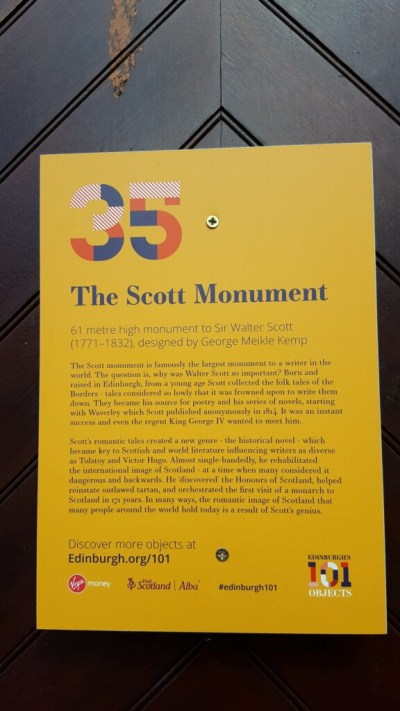
Why did they make her think of me? Because Sir Walter Scott, as the photo of the plaque below explains, created the genre of the historical novel, which is what I write! And, they built a monument to honor him in Edinburgh, Scotland (pictured below). It is the largest monument to a writer in the world! (I jokingly said, “Some day they’ll build one in my honor.” To which my middle son groaned.)    😀

Sir Walter Scott wrote one of my favorite stories, Ivanhoe, which I haven’t read in years, but now I’ll have to revisit.

What do you know about Sir Walter Scott? What did he write that you like?

imagejpeg_0

imagejpeg_0(2)

Something New

As a Christian, I always pray about my writing and ask for God’s guidance in what I write and how I write it. God has been faithful and is blessing my writing.

Sometimes God opens a door you weren’t really thinking about and that’s what’s been happening in my life recently. I have been very active in three different critique groups; one I’ve been a part of for four years, and the other two I’ve been a part of for a little over a year. During that time, I have continued to learn more and more about the craft and rules or guidelines of writing, and I have found that I enjoy critiquing.

Recently, at one of my critique groups, several ladies were impressed with my critiques on their work and a couple of them asked if I am an editor. I paused to really think about how to answer that question. Then I responded with, “I believe I am qualified to be an editor, but I don’t have experience as an editor.”

When I returned home that afternoon, I looked up what exactly editors do and found that, yes indeed, I am qualified to be an editor. I have actually been editing instead of critiquing people’s work, and God has given me a heart to help others.

Suddenly, I’ve had quite a few people contact me and ask me to edit their work or help them with something they are writing (which essentially translates to editing), and I have readily agreed. I believe that God has sent these people to me and has opened a door for me to become, not just a writer, but an editor too.

I will soon have enough experience to confidently call myself an editor. So, keep your eye on my blog if you are interested in an editor or know someone who is, because I will be posting more about what I will be doing as an editor by September.


Let’s Talk About Webinars

Have you ever participated in a live webinar?

I have participated in several. I have found the ones that I enjoy the most are the ones that have been set up by a group or organization that I belong to who do a complete webinar with no sales pitch at the end.

Sales pitch endings — yes, these are the webinars that I have come to strongly dislike. Why? Because they send you an invitation with lots of promises, like “in this webinar you will learn how to make money selling ebooks on Amazon”. There is also information offered about the speaker of the webinar which usually says things like “I used to be a struggling writer, trying to sell my work to feed my family” or something similar to give you a picture that the person had decided to try to have writing as his/her only job and wasn’t doing very well. He/She was struggling to pay bills, make ends meet, feed the family, etc. Then there’s usually something like “I hope you are not in a similar situation, but if you are, I want to help you. That’s why I’m sharing my secret for selling ebooks on Amazon with you. Just sign up to join my webinar, and hurry because space is limited and seats are going fast.”

So, you think to yourself, I relate to this person’s circumstances, and I would really like to be able to sell my (or more of my) books on Amazon. This sounds like a good marketing webinar. Therefore, you sign up and block out the date and time on your calendar to be sure you don’t miss it. (Of course, they send you several email reminders the day of the webinar, right up to start time).

Then with excitement and hopefulness, you tune into the webinar at the appointed date and time with a notebook and pen by your side so you can catch all of the important information. The webinar starts out well, giving you tips, advice and information that you think will be really helpful, but as the end of the webinar time approaches, the tips, advice and information slow down and eventually stop, just short of completing the information you were expecting and looking forward to.

What happens next? The speaker of the webinar begins a sales pitch. Yep, the information was to lure you in to pitch some new website or resource or online classes for writing that will cost you hundreds of dollars.

What happens to your excitement and hopefulness? Well, if you’re like me, it plummets into the pit of your stomach, and you think, “What? I thought you wanted to help the struggling (translate to starving) writers. How can wanting them (me) to spend hundreds of dollars they (I) don’t have, to get the complete information and help your webinar promised, help them (me)?

So, you turn off your computer, completely disappointed/distraught. And if you’re like me, you think, if they really wanted to help me, the struggling writer, why couldn’t they give me the complete information and offer their sales pitch on another webinar, or, why couldn’t they have been honest and informed you that to get the complete “formula”, you would have to purchase something at the end of the webinar? They claim they have made thousands of dollars with their “formula” and they want to “help others who may be where they were”, but in the end, they’re really not much help at all.

The last webinar I participated in, the speaker admitted, about halfway through the webinar, that he uses a pen name and if you search for his name (that he gave for the webinar), you’ll never find him, and he didn’t give his pen name so you couldn’t even look him up to see if his self-proclaimed success was factual or not.

(Sigh) These are all of the reasons I have sworn off webinars that are advertised on the internet or through email. If the webinar is offered through a group/organization that I am part of and know I can trust, I will participate. Otherwise, I’m not interested. I’m tired of empty promises from writers who claim to have found success that others could attain just as easily, only to have them want to make more money off of someone who can’t afford their prices, which also makes me really wonder if what they’re selling is really worth the money they are charging. Oh, sure, they have those little quotes they share that are supposed to be legitimate quotes by people who have learned their “formula” and are using it to become successful, but we all know, those quotes can easily be bought for a price for such purposes.

How about you? Have you participated in any of these webinars? Have you found any of them helpful and legitimate without your having to invest hundreds of dollars? I’d love to hear your story(ies). Please leave comments in the “Comments” section below.

Reply Like No One’s Watching (Writing Tag)

WP_20160301_14_00_26_Pro

This is so exciting!  My very first writer’s Q & A, thanks to my friend Eve Messenger.  Eve has some great stuff about writing and reading that she shares on her blog, so take some time to visit her if you can.

Eve’s Questions

  1.  What are three things you do really well as a writer?  I will say, based on something an editor friend told me, I am good at spelling, grammar and beats.
  2. When you daydream about “making it” as a writer, what do you visualize?  This is easy.  I visualize helping provide toward the household income to a place where we can keep our bills paid and also be able to take a vacation every year.  I also visualize having a loyal group of readers and enjoying successful Book signings.
  3. Do you have a regular writing routine?  If so, when?  This is still a struggle for me, but I am finding more time to sit down and write on weeknights, sometimes even Saturday and Sunday, but nothing is yet an actual routine.  After the end of the current school year, I will only have one child left that i will be homeschooling, having graduated the other two, and I hope to be able to create a regular writing routine then.
  4. Dogs or cats?  Definitely dogs!  I love animals, but dogs are definitely my pet of choice.  They are loving, loyal and obedient.  We had to say goodbye to our first black Labrador Retriever last summer, but we currently have another one that I love.
  5. What’s directly to the left of where you are sitting right now?  My kitchen.  I do most of my writing at the dining room table.
  6. When do most of your plot ideas come to you?  In bed, on walks, in the shower, while driving, while reading other books?  In bed.  Most of my writing ideas, whether plot, characters, or anything else come to me when I am in bed.  I keep a notebook and pen beside my bed so that I can write them down, otherwise they don’t let me sleep.
  7. What’s your most recent writing breakthrough?  Realizing that not every story conflict has to be really big.  A story has to have lots of conflict to keep the story moving and the readers reading and I always thought conflicts had to be big, but at a recent writers’ retreat I shared that I was struggling with putting enough conflicts into my story.  One of the ladies made a suggestion for a very simple conflict and that’s when I realized not every story conflict has to be really big.  It has helped me get back to my writing and to be able to write enough conflicts to keep the story interesting.
  8. Are you able to write in noisy environments?  My answer to this question is both yes and no.  Yes, I can write in a noisy cafe or mall food court because I know none of the noise there has to do with me.  No, I can’t write in my own home if it’s noisy because I usually have to be involved in the noise in some capacity.  The home noise directly affects me; cafe and mall food court noise does not directly affect me making it easy for me to tune it out.
  9. Have you ever attended a book signing event for an author you admire?  If so, what was it like?  This is an interesting question.  The only book signing I ever went to on purpose for the book signing was because the author had been one of my favorite teen t.v. stars who had written his first book.  The line was quite long and they actually ran out of books and he signed book plates to hand out that you could paste into your book when it arrived.  I received a book plate and also was able to get my photo taken with the author.  I would say his book signing was a huge success, but I believe a lot of that success was due to his previous television fame.
  10. Are you better at coming up with titles or elevator pitches?  I struggle with both of these, but I would have to say I’m better at coming up with elevator pitches.  I find it a bit easier to summarize and pitch my writing than to come up with a really good, catchy title for something I’ve written.

Tag, You’re It:

Laura L. Zimmerman

Sue

Blue Moon Thinker

Donna L. H. Smith

The Rules:
1. Thank the blogger who nominated you and link to their blog and Twitter in your post.
2. Answer the questions that the blogger who nominated you has provided.
3. Nominate up to 10 other bloggers or Twitter followers
4. Create ten questions for your nominees and notify them of their nomination.

Kelly Barr’s Questions:

  1.  Who are your top three favorite authors?
  2.   Are you a plotter, pantser or something in between?
  3.   Where do you do most of your writing?  At a cafe, a room in your house, etc.?
  4.   What’s the biggest writing challenge you are currently facing?
  5.   Do you listen to music while you write?  If so, what kind?
  6.   Coffee, tea or hot chocolate?
  7.   If you could ask any writer, past or present, one question, who would the writer be and what would you ask?
  8.   How do you get past being stuck in your writing?
  9.   What do you do to relax?
  10.   What is your favorite movie that’s based on a book?


Writer Interview

Today, I want to introduce you all to my writing friend, Julie Helms.  She was kind enough to answer some questions and allow me to post the interview here.

Me:  What piqued your initial interest in writing?  and How long have you been writing?

Julie:  I started writing only after I turned 40.  In high school, a teacher wrote on my progress report that got sent home:  “Julie can’t write, and she’ll never be able to.”  I can’t stress the amount of damage that comment did to me.  I actively resisted all writing after that through high school and college.

In college, I took a required English course taught by the VP of the university.  She called me into her office one day.  She wanted to know why on earth I was majoring in biology instead of something to do with writing.  She said I was a promising writer.  I just simply didn’t believe her…didn’t she get the memo?…the one that said I can’t write and will never be able to?

Two years later, a second professor called me out publicly during class in a lecture hall.  He had given the class a writing assignment that he felt was so difficult that he made it pass/fail only (it was to write a Greek comedy play).  So he was passing the assignments back and he announced my name and walked up to my desk (as a desperately shy person, I wanted to dig a hole, curl up, and die.)  He told the class my play was so well written there was no way he could just give me ‘pass.’  He gave me an A+.  Of all his classes, he said, I was the only one to get this.

You would think that after that I would embrace my inner muse and apply myself to the craft of this great calling.  But that careless comment from my high school teacher just screamed inside my head.  I sure showed my college prof…I threw my Greek play in the trash and I never attended another class in that course.

I wrote nothing for the next 20 years.

About ten years ago, I discovered Helium.com.  It was an online writing site that anyone could post to.  It didn’t matter if you could write or not, it was open to everyone.  Some little niggling in the back of my mind encouraged me to just give it a shot.  It sounded fun.  I posted under a pen name so I wouldn’t embarrass myself if my writing really sucked.  I was pleasantly surprised when I began to win some contests they held, and even more shocked when outside companies began purchasing my articles.  Helium went out of business about five years later.  In that time I had written 126 articles, stories, and poems.  About 20 of them were purchased for publication elsewhere.

Before they went under, Helium hired me as a freelance writer and editor for a different branch of their company that specifically offered professional writing services to other companies.  It wasn’t anything sexy, but it included writing for real estate companies, email coupon sites, and Sears and Kmart catalog descriptions.  It was during this time period that I discovered I had an aptitude for editing and really enjoyed it.  This branch of Helium (Content Source) was purchased by RR Donnelly, who I continue to work for to this day as a freelance editor.  My biggest customer is Amazon’s CreateSpace, their self-publishing arm.

To this point, I’ve sold only nonfiction, informational-type writing, which I don’t find particularly stimulating.  I want to write stories!

Me:  What types of things do you like to write?

Julie:  My focus now is on short stories and a novel-in-progress.

Me:  Do you study writing?

Julie:  I took my first writing course this fall from Gotham University online.  It was Fiction I.  I’m now taking a course from the same university called Novel II.

Me:  What do you consider important resources every writer should have?

Julie:  As basic as it sounds:  access to a dictionary and thesaurus!  I also love my most recent acquisition of The Emotion Thesaurus.

Me:  Do you like to read?

Julie:  Yes, I do now.  I was very late to discover the joy of reading.  Though I could read from the time I was supposed to in grade school, it was laborious and nothing close to fun.  I was in 9th grade when I read my first book for enjoyment.  It was like a light came on in my brain.  I then became a voracious reader.  Currently I read two to three novels per week.

Me:  Do you believe it is important to read in order to be a good writer?  Why or why not?

Julie:  Based on my history, I think the connection between reading and writing is obvious.  When my high school teacher said I couldn’t write, I probably really couldn’t…because for one thing I really hadn’t started reading yet, at least not easily.  In my fiction class this past fall, my teacher commented on my first submitted work that I had done three particular things very well.  I had to look up all three terms she used–I had no idea what they meant, so it’s pretty obvious I didn’t do any of it intentionally.  I told her this and she asked me if I liked 19th century writers.  I said I do.  She said I was modeling my writing techniques after them.  So I think the read/write connection is a strong one.

Me:  What is your favorite genre to read?  Why?

Julie:  Depends.  The vast majority of the reading I consume is commercial fiction.  I watch literally zero TV, so reading takes the place of that.  And most of the time I want to just read for entertainment.  It could be romance, crime drama, or psychological thrillers.

Occasionally, I will pull out something more along the lines of literary fiction.  That is when I’m in the mood to really enjoy the writing itself, the sound of the sentences–and I often do read it out loud.  This would be my 19th century writers…maybe Jane Austen, Edgar Allen Poe, or Nathanial Hawthorne.  I can read the first paragraph of Pride and Prejudice ten times and get the same thrill each time–the writing is to be slowly savored and appreciated.  As politically incorrect as it is to say this, I dislike much of what is touted as classics in 20th century literature.  I find them pretentious, self-absorbed, and frankly boring.  Just shoot me before making me read any more Faulkner, Hemingway, or JD Salinger.

Me:  Who is your favorite author?  Why?

Julie:  Commercial fiction:  Diana Gabaldon.  I love her Outlander series.  What a beautiful mix of romance and adventure with a little sci-fi thrown in.  I think she is a wonderful writer, though verbose at times.

Literary fiction:  Nathanial Hawthorne.  The man can set a scene like no one else.  You can feel the creepiness and ennui of The House of Seven Gables creep into your bones while you read.  you can feel the shame and hypocrisy close in on you in The Scarlet Letter and The Minister’s Black Veil.  Actually Poe does this very well, too.  The Fall of the House of Usher…best story ever!

Me: What was your favorite book as a child?  What did you like about it?

Julie:  Reading was such a chore for me, so ‘favorite’ would be overstating it, but I do remember liking The Borrowers when it was assigned in 6th grade.  I was fascinated by stories of fantasy lands.

Me:  When and where do you write?

Julie:  Usually in my recliner in the sitting area of my bedroom.  I am nothing if not a creature of comfort, plus it is the only place in my house that I can escape all other humans for a time.  I do everything on computer, no writing in notebooks.

Me:  Do you have an established writing routine?

Julie:  No, but I need to.  Unfortunately, life keeps getting in the way.  I write in fits and spurts, but I would like to be disciplined and intentional about it.

Me:  Do you like to listen to music when you write?  If so, what type of music?

Julie:  I absolutely cannot listen to music when I write.  I also can’t have much activity going on around me–no TV, conversation, etc.  Participating in our Scribes Oasis writing group is really the only time I write with people in my vicinity, since I am a big one for talking through problems out loud, and that’s embarrassing to do with witnesses!

Me:  Are you part of any writers’ groups?

Julie:  Scribes Oasis and an online writing class I take through Gotham University that functions as a writing group in some ways (eg. interaction with others, critiquing).

Me:  Do you think it’s important to be part of a writers’ group?  If so, why?

Julie:  I think it is very helpful.  I’ve used my group to brainstorm ideas when I was stuck and to get feedback on what I’ve written.  I think the feedback is especially important so you can see what’s working and what isn’t.

Me:  Have you ever written anything that was published?

Julie:  When I wrote for Helium.com I sold dozens of articles, mostly short nonfiction, for publication usually online.  Topics varied from info about insects or farm animals, to military history, to biblical concepts.  I have contributed to a coffee table book about cats, as a ghost writer.  And I’ve had a poem and autobiographical account stolen and printed online without permission–does that count as publication?  🙂

Me:  Do you have a blog that is related to your writing?  If so, what is your blog address?

Julie:  Not at this time.

Me:  Do you think it is important for a writer to establish an online presence?  Are you on any social media?

Julie:  It probably is, but this would be an area that I know little about and need to learn more.  I use some social media but not yet related to my writing.

Well, Julie, it’s been a pleasure chatting with you and learning about your writing journey.  I certainly wish you the best as you continue to write, and hope to read your novel after publication.

Where Have the Editors Gone?

I am a person with strong opinions, especially about things that I am passionate about.  This is how a conversation I had with a friend from my Thursday writing group became the topic of this post.

We met last night since this week, Thursday is New Year’s Eve, and Susan asked Laura if the story she recently finished will become a series.  That led us to discussing how you can create a series from a story you didn’t mean to be a series, if a publisher/editor ask you to make it a series.

That led to Laura mentioning an author who she enjoys reading, who writes books with good storylines, but she said it is also obvious that the writer isn’t a strong writer and there are often errors such as spelling and grammar even with a traditional publisher, which caused me to ask “Where Have the Editors Gone?”

Everything I have learned is that we have to be strong writers and we need to put out our very best.  We need to do a lot of reading, especially in the genre we want to write, and we should find at least one writers’ group to be a part of, and we should never stop studying the craft of writing.  I’ve heard the stories about hundreds of rejections and the demanding editors.

Yet, so many, even bestselling writers, are getting published and hitting bestseller status, yet they’re writing is lacking.

My question then is “Where have the Editors Gone?”

So, Laura asked an agent about this.  She wanted to know how this is possible.  How are these books not getting edited?

The response she received was that they have already established a following and the books are selling.  It all depends on numbers and as long as you’re making big money, the publishers and editors don’t care whether the writing is good quality.  This agent also mentioned that this is also why you will sometimes read an earlier book by a writer that is better written than later books because often good writers will stop working hard to do their best once they hit big numbers because they don’t have to produce the same quality once they’ve become successful.

To all of this, I say, “WHAT?!  It is ridiculous that today’s readers are accepting poorly written books and then hailing them as “wonderful” in book reviews, blog posts, and on Good Reads.  For goodness sake, can you at least write an honest review and let the author know that you like the story line but think they should improve their writing.  It is possible to do this in a kind way.  I have done it.  Just read this post for an example.  I believe I was honest without being harsh in this post and I even complimented the writer near the end of the post on what I noticed may be her strength.  Just because the many publishing options make it so much easier to publish today, and just because you may build a large following should not be an excuse to not produce your best possible work.

I have always been a bit perfectionistic and would never dream of producing less than my best.  Also, I believe that I am called to strive for excellence.


Profanity — Acceptable or Unacceptable

Okay, so I have heard differing views on this in the Christian writing realm, and was surprised when I attended a workshop recently where the speaker spoke about the importance of including “absolute truth” in our writing, be it fiction or nonfiction. This speaker also stressed that “absolute truth” only comes from the Bible, which I completely agree with.

The speaker also spoke about the difficulties of getting published with a Christian publisher because they have very strict rules, and the speaker mentioned that if we, as writers, want to reach non-believers, we won’t be able to do that if we publish with a Christian publisher, which I tend to agree with.

However, the speaker also said that it was okay to use profanity; that it makes it more realistic.  (This is something I have heard many times before).  I have been thinking about the contradiction in that workshop — “absolute truth” from God’s word, which clearly says, in Ephesians 4 and 5, where Paul is preaching about believers living as children of the Light:

“Do not let any unwholesome talk come out of your mouths, but only what is helpful for building others up according to their needs, that it may benefit those who listen.  And do not grieve the Holy Spirit of God, with whom you were sealed for the day of redemption.  Get rid of all bitterness, rage and anger, brawling and slander, along with every form of malice.  Be kind and compassionate to one another, forgiving each other, just as Christ God forgave you.  

Be imitators of God, therefore, as dearly loved children and live a life of love, just as Christ loved us and gave himself up for us as a fragrant offering and sacrifice to God.  

But among you there must not be even a hint of sexual immorality, or of any kind of impurity, or of greed, because these are improper for God’s holy people.  Nor should there be obscenity, foolish talk or coarse joking, which are out of place, but rather thanksgiving.  For of this you can be sure:  No immoral, impure or greedy person — such a man is an idolater — has any inheritance in the kingdom of Christ and of God.  Let no one deceive you with empty words, for because of such things God’s wrath comes on those who are disobedient.  Therefore do not be partners with them.

For you were once darkness, but now you are light in the Lord.  Live as children of light (for the fruit of the light consists in all goodness, righteousness and truth) and find out what pleases the Lord.”   (Ephesians 4:29 – 5:10)

I know that I could have simply shared Ephesians 4:29, but many people make accusations about taking scripture out of context, so I wanted it to be clear that the context is clear.  There is no question that we are not to participate in such behaviors, according to the “absolute truth” of God’s word, the Bible.

Therefore, if we are not to participate in those behaviors with our mouths, isn’t also our responsibility to not participate in those behaviors with our pen or keyboard?

As for the thing about using profanity making it more realistic, I have to say that I live a real life and do not use profanity, and in my real life it has been my experience that when others know that I do not use profanity, even if it is a normal part of their speech, they try not to use it around me and if they slip and use it, they immediately apologize.  My husband has told me the same thing happens to him.

Finally, I have to say that I know many people who use profanity daily, and yet I have never heard them complain about a book that they have read or even a movie or T.V. show that they have watched stating, “That was unrealistic.  There wasn’t enough profanity in that.”  Nor have I heard any of them base their like or dislike on a book, movie or T.V. show on how much profanity, or lack thereof, was included.

Therefore, I will continue to stand on my convictions and write profanity-free.

What do you think?  Profanity — Acceptable or Unacceptable?