Big News!

I’m sorry if you came looking for a Flash Fiction Friday post here today, but I just couldn’t wait to share my “Big News”. Flash Fiction Friday will return again next Friday.

The photo below is the cover reveal of a book that holds thirty-three personal stories of God’s provision for the writers’ lives, and I am one of the thirty-three writers who has a story inside!

The following was taken from CrossRiver’s website, explaining a bit more about them and this book:

God’sPromisesHoldTrue

For us here at CrossRiver and for many of our authors, it has been a challenging year. Our mission is To glorify God by providing high-quality books and materials that ignite an individual’s relationship with God and inspires them to lead lives that honor Him.

Satan doesn’t want God to be glorified, so the enemy strikes where he can. Psalm 34:19 NLT tells us:

The righteous person faces many troubles,
but the Lord comes to the rescue each time.

God’s promises hold true. He is faithful. We can trust him.

However, we all need encouragement now and then. To that end, in November CrossRiver is releasing our newest anthology, Abba’s Promise: 33 Stories of God’s Pledge to Provide.

Why 33 stories? Because in biblical numerology 33 means promise, and that’s what this book is all about.

From our smallest to biggest need, God has promised to provide. And Hebrews 10:23 NLT tells us, “God can be trusted to keep His promise.” His promises anchor our hope. Additionally, our personal testimony is a powerful weapon against Satan. “They overcame him… by the word of their testimony” (Revelation 12:11 KJV).

From the provision of finances to His guiding presence to angelic protection, Abba’s Promise offers you 33 stories filled with hope and encouragement for today.

Debra Butterfield is an editor for CrossRiver and it was a pleasure working with her to get my story into this lovely anthology. You can read more about her at the CrossRiver website.

You can preorder this book of encouraging stories for just $9.99 (plus shipping and handling) at:

http://www.crossrivermedia.com/portfolio/abbas-promise/gallery/bookstore/

Anyone who knows me and would like me to sign your copy, I would be happy to do so.
Between Plotting and Pantsing

I have written here in the past about writing as a pantser and my attempt at becoming a plotter, and what I have found is that what works best for me is something between the two. I know there is a lot of talk about plotting and pantsing and many writers try to fit into one mold or the other or struggle to find their fit, so I am going to share my writing process in hopes of helping other writers who might find it more comfortable somewhere in between.

When I began my current WIP, I wrote down my two main characters’ (protagonists) physical descriptions, personality traits and their back stories. I did the same thing for my antagonist. Then I found some great sheets, that are FREE from a great website for writers:  Writers Helping Writers in their “Tools for Writers” section, called “Reverse Backstory Tool” and the “Character Pyramid” which I found helpful and not overwhelming, and I filled one of each of those out for my two main protagonists and my antagonist. I also wrote down the main plot and conflicts that I knew I wanted to include in the story.

Since I have decided that clean historical romantic fiction is the genre I am passionate about writing, I also did a little bit of research in regard to  the setting: historical time period and the real life towns that would be mentioned in my story and that would be home to my main characters; and into the life of some real life people who did the job I wanted my main male character to do so that I could make him as realistic as possible, and so, of course I also had to research that particular job. This sounds like a lot of work and plotting, but I didn’t feel that way, and writing something historical requires historical accuracy. I enjoyed the research almost as much as I enjoy the writing.

After that, I began my writing. In the midst of  working on this novel, I participated in two writer retreats where we did a couple of cool exercises that gave me a bit more insight into my main male character. I have also attended one writers’ conference, where I spoke with two published authors and shared a portion of my writing and they gave me helpful feedback. I am also a part of two different critique groups where I frequently share a piece of this novel for feedback. All of this feed back helps me to improve the story, and think about what I might be missing, which led me to contact a museum for more information about the historical aspects of my story (you can read about this here.)

I have also had to pause to research a few more things I needed to know about horses and riding and caring for horses. So, as you can see, because I do most of my writing as a pantser, I end up having to occasionally pause to research something I didn’t think about or anticipate before I began writing. Also, just because knowing that I have mistakes or missing parts in what I’ve already written, I cannot continue writing without fixing, changing and/or adding as needed during my writing sessions, so that interrupts my writing as well, but I’d much rather take care of those things as soon as possible and not have to go back and do ALL of those edits after finishing the entire novel. Taking care of it in bits and pieces is much less overwhelming to me. That’s why I submit to critique groups.

Some say that I am creating extra work or that it takes a lot more time to write the way that I do with these interruptions, but I don’t see how it takes any more time than all of the plotting some people do, and then writing the entire novel, and then going back and having to edit the whole thing. I think if a plotter and someone like me actually wrote down our time for the entire process, it really wouldn’t be that much different, assuming we are writing the same genre.

I hope that this information will be helpful for at least one of you out there.  Let me know if you’ve found it helpful or would like more information on any of this by dropping a comment in the comment box below.

Happy writing!

It’s Here — Research Materials!

IMG_3124

IMG_3123

IMG_3122

You are about to get a small sneak peak into the novel I am working on.

Drum roll, please.    “Rat-a-tat-a-rat-a-tat-a-rat-a-tat-a-rat-a-tat-a-rat!”

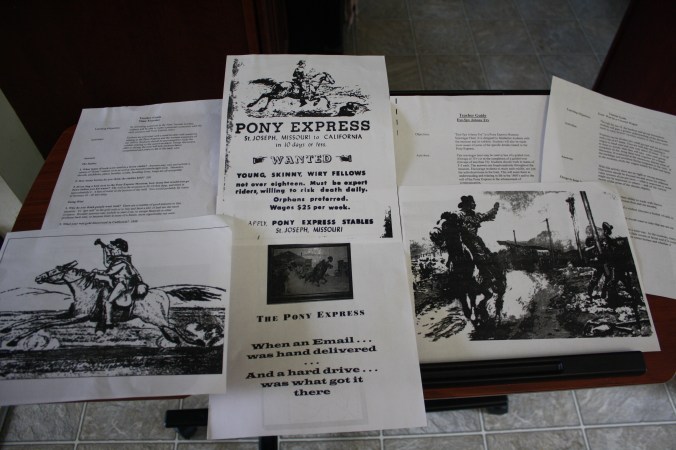
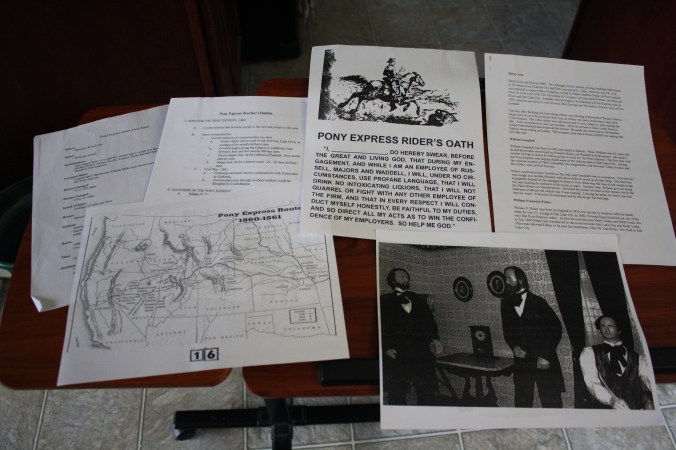
My current work in progress (WIP) is an historical romance novel set in St. Joseph, Missouri in 1860, the year that the Pony Express began, and yes, my main male character (protoganist) is a Pony Express rider.  I am doing my very best to keep the historical aspects true to history, so I have done quite a bit of research but still wanted more.

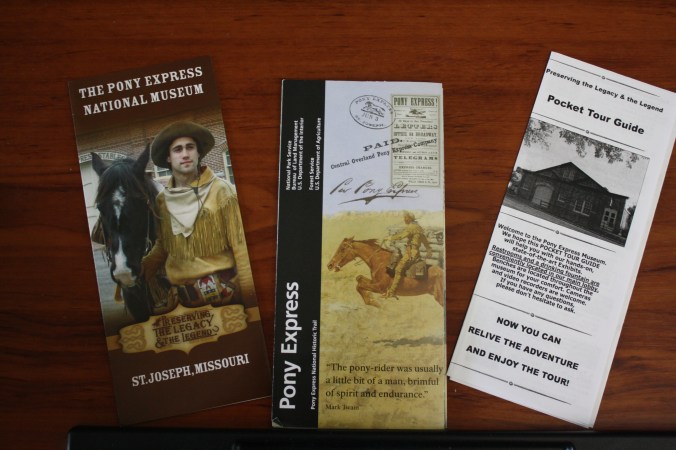
Therefore, after scouring the St. Joseph, Missouri website as well as a few other websites, I decided to call the National Pony Express Museum that’s in St. Joseph, Missouri and see if they had any materials they could send me. I spoke with a very nice young lady on the phone who said it would be no problem to send me a packet of information.

I was excited and eagerly checked my mailbox daily watching for the packet’s arrival. After about three weeks, I thought that snail mail had either seriously slowed down or the packet wasn’t sent or it got lost in the mail. So, I called the museum again and spoke to the same young lady, who remembered speaking to me and asked me how my novel is coming! Then she apologized that I didn’t receive a packet of information and she promised to take care of putting it together and getting it sent.

It arrived last Monday, and I was so excited!  I am enjoying reading over the material and adding information to what I already have. I am having so much fun researching and writing this novel!


Camp NaNoWriMo

Okay, so I’m sure you’ve heard of NaNoWriMo, National Novel Writing Month, which takes place every November, where the goal is to write a 50,000 word novel in the thirty days of November.  Well, I have not participated in the November NaNoWriMo yet.  Seems too stressful to me in a month with a major holiday, right before a month with an even bigger major holiday, two of the three holidays that are most important to our family.

But, now there’s Camp NaNoWriMo in the month of July!  This one lets you set your own goal for the month of July.  You also get to be part of a group who share a “cabin” (this is all online), where you can encourage each other throughout the month through messages you post in your cabin.  You write in whatever program you normally write on your computer and simply update your word count every time you write and add words to your novel or whatever project you are working on.

I chose to do this because a couple of friends were doing it and encouraged me, plus I needed some motivation, but not too much stress.  So, I had about 14,000 words written in my novel in progress, so I set my goal for 30,000 words.  I figured that was more than half of what I’d already written, but still a challenge for me.

Here we are on the 10th of the month and I have not written every day, but I am still on track to meet my goal according to the stats the Camp NaNoWriMo website keeps for me.  Seeing that helps my motivation too.

Another motivation:  If I succeed in reaching my goal by the end of the month, I will get a badge to post here on my blog, and that might not be a great prize, but  I do NOT want to fail, so the fact that some of my friends, and now all of you know that I am doing this will also keep me motivated because if I don’t post a badge on my blog by the end of the month, all of you will know that I failed, and I CAN’T HAVE THAT!     😀

How about you?  Have you ever participated in NaNoWriMo or Camp NaNoWriMo?  What was your experience?

A Great Research Resource

When you write historical fiction, there is a need to do some research:  research on the time period, the clothes people wore and the foods they ate during that time period, the cost of things during that time period, occupations of that time period, the way people spoke/words that were and weren’t used and more.  Also, if your story is set in what was a real place in that time period, you need to know what that place was like, what the weather was like, what the land and buildings looked like.

In addition to time and place, you may choose to have one of your characters working a job you are unfamiliar with or that is no longer an occupation in today’s world or that requires them to work with tools or animals you are unfamiliar with.  These things will then need to be researched also.

Research is time consuming, but it can be quite fun.  You will learn interesting things that you may find fascinating.  You may even find them leading you to research something else as another idea for something to include in your story may arise.

Being something between a plotter and a pantser, when I was in the beginning stages of my novel, I researched what I felt I needed to have accurate information about; mostly setting — place and time period.  I also researched names to be sure my character’s didn’t have names that couldn’t possibly have been used in the time period.  I had a good idea of what people wore but I still did some research to be sure, but I didn’t spend as much time on this as I did on the setting components.  I researched a couple of occupations, one a lot more than the others.

Okay, you might think, but where did you look for the information you needed?  Well, I did a lot of research online.  The internet is a wealth of information, as long as you are careful and check that the websites and/or blogs you get your information from are accurate and legitimate.  I never go to Wikipedia without checking other places to be sure the information lines up, and I rarely use Wikipedia.

One great source for historical research are the websites of museums.  In addition, you may want to call the museum and ask if they have any information they would be willing to send to you through snailmail.  I recently did this and was surprised at how easy it was.  I thought I may have to pay a fee, at least to cover postage and handling, but the lady I spoke with was willing to gather information and send two packets to me.  I was so excited!  I can’t wait for these packets to arrive.  I check my mailbox everyday, Monday through Saturday.  It is is currently about a week and a half and I’m still eagerly awaiting my packets.

Other great resources:  if your story’s time period isn’t too far in the past, older folk who lived during that time love to share memories, books (biographies, diaries and journals or logbooks written by someone who lived in your time period) are still a great resource, speaking with an historian who specializes in your story’s time period, and old newspapers or newspaper archives.  Of course, if your story’s setting — place, isn’t too far away and it’s feasible for you to go there, visiting the actual place and checking out the museums and historical tourist spots is a great resource that really gives you a visual and makes your story’s place come to life.

Do you write historical fiction?  What is your favorite research resource?

Writing Strengths and Weaknesses

Today I’d like to share about the strengths and weaknesses in my writing in hopes of encouraging some of you.

I’ve been writing for a long time, although I took quite a few years off to raise and homeschool my two older sons.  I returned to writing three years ago and now am fairly immersed in the writing culture as I am a member of a large local writing group, a huge national writing group (most of which I participate in online), a small writing group that I started which is quite different from the first two mentioned, as well as two critique groups — one online and one that meets face-to-face.  In addition to that, I attend at least two small writers’ conferences a year and have connected with quite a few writers online through social media. In addition to all of that, I have this blog.

All that to say that I AM WRITING!  Also, I have learned A LOT over the past three years, and continue to learn daily.  One of the things I learned most recently is what I am really good at writing and what I really need to work on in my writing, novel writing/fiction writing.

So, I will start with my weakness — description/setting the scene.  You see, I have the scene and the characters so ingrained in my brain that I forget the reader cannot “see” it and I simply write the action and dialog with very little description and scene setting.  Another reason this happens is because I have heard many people, in the writing world, over the past three years, say things like, “Be careful not to include too much description because it will bog the story down”; “readers don’t want a lot of description”; “too much description can be too telling instead of showing”.  Because of these statements, I think that I simply avoided description.

However, over the past three months other writers have been explaining to me how important some description is so that your reader can picture the scenes in their minds.  I’ve been told how important it is to include the five senses.  I have some wonderful suggestions and examples from other writers that are helping me learn to do this, but I have to be deliberate about it.  I have to re-read every scene I write to be sure I included some great description and use of some of the five senses to bring my writing to life.

Yes, as I use description and the five senses, I do see my novel coming to life.  So some description and use of the five senses is important because it breathes life into the story!  This is hard work for me because it doesn’t come naturally yet.  As I said, I have to be deliberate about it, but I am finding it very rewarding, and I believe it will come more naturally the more that I do it because the more that I have done it over the past few days the more comfortable I have gotten with it.  However, I will still rely heavily upon my critiques to be sure that the descriptions I write are of good quality.

Now my strength — dialog!  Good dialog just flows from my brain onto the page.  I was recently made aware of this when several other writers and my critiquers commented and praised my written dialog.  I believe this is because I am so in tune with my characters and their personalities and character traits.  I’ve never had to work hard to write dialog.  It comes easily and naturally.

What do you find comes naturally from you for your writing?  What do you have to work deliberately on in your writing?  Leave a comment below and share.  I’d love to hear from you.

What I’ve Learned About Critique Groups

There are different types of critique groups and it’s important to try several different types until you find the one you think fits you best and is most helpful to you in your writing.

I have been involved in two different critique groups and will begin my journey with another critique group this week.  The two that I have been a part of seem to have the same basic rules:  start by saying something positive, offer your thoughts on what works and doesn’t work in the writing or where things tend to drag, and end with something positive.  Also, be specific!  Saying something like, “This is nice.  I like it,” is not really helpful at all to the writer.

Of the two critique groups I’ve been involved with so far, I do prefer one over the other because one group has difficulty critiquing the piece you bring to share.  Because you may be working on a novel and you have brought early chapters in the past and now you’ve brought middle or later chapters, and this group may or may not consist of people who read the earlier chapters, it seems to be quite difficult for them to simply critique what is before them.

I understand that it can be difficult as far as knowing how things began and why what’s happening is happening now, but I don’t find it difficult to be able to focus on the words before me and give advice on what is happening on these pages.  Whatever I am reading to critique, I simply, ask myself several questions as I read:  1) Does the story flow? 2) Does the dialogue move the story forward and is the dialogue relevant to the story? 3) Are the goals of the main character clear from the action, the decisions and choices the character makes? 4) Are there any places that cause the story to lose momentum, slow down and seem to drag? 5) Are there any places that confuse the reader?  6) Are the writer’s word choices fitting for the time the story is set in or are there word choices that are too modern or too outdated? 7) Does the story capture and hold my attention and make me want to keep reading? 8) Do I care about the main character? 9) Does the plot line keep my interest and does it keep the story moving? 10) Is the story unique compared to other stories in the same genre?

There may be more questions that pop into my head as I read that I look for answers too as well, but the ten I listed in the previous paragraph are some of the most important, so if you can keep those questions in your head while reading someone’s work, it shouldn’t matter whether you are reading a piece of writing from the beginning, middle or end of the story, in order to give the writer good quality, helpful feedback.

* * * * *

Now, just a bit about the critique group I will be getting involved with this week.  It is the online critique group offered through the ACFW website for ACFW members.  I am really excited about this because it sounds like it may be the most helpful critique group yet.  In order to become involved in the critique group, I have to take a three day orientation, where I will receive three email assignments each day of those three days to complete, in order to learn the rules and how their critique group works.  It’s a very large group and it has smaller branch groups as well, from what I understand.  I am really looking forward to it!  I’ll let you know what I think, once I am able to receive and offer some critiquing.

What about you?  Are you part of a critique group?  How do you benefit from your critique group?

A Thursday Tribute

I have never done this before, but I really feel like I need to do this.  I want to pay tribute to two people who mean a lot to me because of their support and/or contributions to my writing life.

First of all, my husband.  I just have to say how much I appreciate the way that he shows his support for my writing.  How does he do this?

He never complains about my attending all of the monthly LCW (Lancaster Christian Writers) meetings that I want to attend, which is all of them, (smile).  In reality, I usually end up having to miss one or two because of family things that come up that take priority.  He also never complains when I find a free or inexpensive one-day writing event that I want to attend, and he doesn’t mind when I leave two, sometimes three evenings a week for two or three hours to get together with other writers for critique group or to write, brainstorm and encourage each other along our writing paths.  He doesn’t complain that I spend so much time writing and participating in writing related things and yet am still not adding to the family income.  He understands that it is a long process.  I am blessed to have a husband who quietly supports me and I greatly appreciate him.

The second person I want to pay tribute to is a fellow writer who has become a very dear friend and is moving to the other side of the country, Laura Zimmerman.  I met her at LCW but our bond of friendship began when she and I both attended a one day writing workshop in the private home of a complete stranger.  We were surrounded by strangers, and I think, because we recognized each other’s faces and knew we were both part of LCW, we both felt more comfortable and we sat together for the workshop and had some time to talk a bit and start to really get to know each other.

Then when I started the weekly writing group for those of us homeschool moms who often struggle with finding time to write without interruptions in our own homes, Laura soon became a regular part of that writing group, Scribes Oasis.  She has rarely missed a night of Scribes.  Laura also encouraged me in my ACFW (American Christian Fiction Writers) membership, as I was debating renewing my membership.  You see, ACFW is a national organization, and though we have a local chapter, most of the best resources of ACFW happen online, and for the first entire year, I didn’t really get involved in that online community.  Again, lack of time, as family takes priority.  Laura encouraged me because she was involved in a couple of the things that the online ACFW community offered.  So, I renewed my membership and have jumped into getting involved with both feet, and I’m loving it!

Through all of these wonderful writing groups, Laura has also encouraged me in my writing.  She has offered me great advice on my writing.  She has gotten excited about stories I have written or am writing.  She has helped me talk through some issues that came up in my writing that I wasn’t sure how to improve or write well.  Laura is a little bit ahead of me in the writing world, as this year, she obtained an agent and she has submitted three story proposals to this agent already.  He has already gone over the first one and told her what she needed to do to edit the story and improve it, and she literally pulled her story apart and put it back together again, and she believes it is better than the original.  It broke my heart to see her go through that, but her positive attitude through the whole thing and the happiness she shared about the finished edited product was quite an inspiration to me.  Also, the fact that she is a homeschool mom who still homeschools three children and still finds time to crank out stories, and now, devotionals and articles, amazes and inspires me and makes me believe that I can obtain those things too.  I just need to keep working.

So, when Laura leaves after Memorial Day weekend, I will miss her so much, but I am so thankful for today’s technology which will help us to be able to remain close friends who will still be able to encourage and help each other in our writing.  Thanks Laura for your friendship and your encouragement and support in my writing.  I know God has good things in store for you and your family wherever He leads you.

How about you?  Who is a big support and encouragement to you in your writing journey?

Writers’ Retreat #2

On Saturday, we held our second writers’ retreat.  One of the ladies from our PA chapter of ACFW held it at her house, but it wasn’t strictly for ACFW members and we had a nice turn out.  There were nine of us this time.  If I’m not mistaken, that’s two more than last time.

I led another creative exercise in the morning to get our creative juices flowing.  Then we had a brainstorming session to talk about our current work in progress or any other writing project we thought we could use some brainstorming.  At first, I didn’t think I had anything I needed help with.  I don’t have any short projects in the works right now and I don’t seem to be struggling for blog posts either.  However, Lisa, the hostess, asked me questions that got me to thinking, and I decided to ask a question and share a scene from my current novel.  I’m glad I did because even though it was hard to hear something negative about the scene, it ended up being a big help, and the fact that we had a free writing session immediately following the brainstorming session gave me an immediate opportunity to rewrite the scene, making it much better.

After lunch, we had a lesson that Donna led about self editing.  I don’t mind saying I did not enjoy this lesson.  It was very difficult.  I know that self editing is important, and I also know why she had us do the lesson she had us do, but I still didn’t like it.  She had us choose a long paragraph from our current work in progress and count the words in it.  Then she gave us five minutes to cut that word count in half.  After that, she had us count the words again to see how we had done.  Then she gave us another five minutes to cut that number in half.  This exercise was an epic fail for me.  You see, I don’t have very many long paragraphs in my work in progress.  I struggle with including enough description to properly set my scenes, but am talented at writing good dialogue and action to keep the story moving.  Therefore, I am not an overly wordy writer so it was extremely difficult to cut a paragraph without removing important information.  I do understand the need to do this, though.  I watched a friend struggle through having to make a lot of cuts to her first novel according to her agent’s guidelines to attempt to find publishers who might be interested in publishing that novel for her.  She is extremely happy with the final results but she struggled and worked extremely hard to get there.

That is not to say that I am not willing to struggle and work hard to put out a really good final product, but I don’t think I will go about it the way that Donna had us do.  I know I will start by looking for all of the “over used” words.  You know, words we use over and over again because we tend to write like we talk or think.  I know I will have to change, cut and find synonyms to correct this problem.  I’m sure there will be other things I will have to cut as well, but I’m not really ready for that stage just yet and I need guidelines to be able to determine what really needs to be cut and what doesn’t.

How about you?  What have you experienced with self editing?

Procrastination

To procrastinate is to go against the old saying, “Never put off until tomorrow what you can do today.”

The Merriam-Webster definition of procrastinate is “to put off intentionally and habitually”; “to put off intentionally the doing of something that should be done”.

I am constantly battling procrastination when it comes to my writing.  I make time to post here on my blog.  I make time for Facebook and Twitter.  Why do I keep procrastinating writing my novel?

I WANT to write my novel.  I LOVE the characters I have created for my novel.  I LOVE my plot line.  I LOOK FORWARD to having people read my novel.  I even have a plan that seems workable to create a schedule that would allow me to write 5 or 6 days a week.  So, what’s my problem?

I think I still have a mental block that I thought I had conquered.  When I was younger and braver and more confident in my writing I never procrastinated.  I finished every story I started back then.

It’s not that I’m not finishing stories now, but I’m taking much longer and it’s not just because I have other responsibilities.  However, I never received the encouragement I wanted or hoped for when I wrote without procrastination in my younger years.

Now, I have others who are encouraging me.  However, I wonder if I subconsciously take their helpful critiques as negative criticism, even though I seek their critiques.  Consciously I don’t feel like they are being negative or mean in any way.  I find their advice helpful for the most part, and I have learned when it is necessary to disregard advice that wouldn’t be helpful for improving my writing (I received good advice on how to tell the difference).

I really want to conquer this procrastination!

Have any of you struggled with this?  What have you found to be helpful to getting past your procrastination?  Please leave comments.  They will be greatly appreciated.