Are You and Outliner or a “Pantser”?

Are you an outliner or a “pantser”?  What is a “pantser”, you may be wondering?  Well, a “pantser” is someone who writes “by the seat of your pants”.  In other words, they sit down and just start the story with very little planning or without developing any kind of written road map to follow.  Which one are you?

I’ve always been a “pantser” myself.  Everything I have written over the years has been done by the seat of my pants.  And, guess where all of those stories are — in a box — most of which are unfinished and all are unpublished.  Being my toughest critic, I didn’t think any of the finished ones were worthy of submission for publication, and the ones that are unfinished, are unfinished because I lost my way and the plot line faltered.  As a very creative person, I do not want to do anything that would stifle my creativity, as that is so important in writing.  Therefore, I refused to do an outline.  I felt it was too businesslike, too structured and too formal and, therefore, it would kill my creativity and the story would fail a-gain.

Then I read Outlining Your Novel by K.M. Weiland, available at Amazon.com both in paperback and Kindle.  I have the Kindle edition and I devoured that book, while taking copious notes.  It was a wonderful tool to help with my writing as it showed me that outlining doesn’t have to be the formal Roman numerals and lower case letters that we learned in high school. You can think outside of the box and create outlines that encourage your creativity!

K.M. Weiland suggested, for visual learners (which I am one), to use colored note cards pinned to a bulletin board instead of putting your outline on your computer, or you may want to use the extensive sketching and planning method. She suggests that we never be afraid to experiment. She discussed “Different Types of Outlines”: The standard “list” outline, Mind maps, Pictorial outlines, the map, and the Perfect Review.

The other great thing about this book is that she does a brief interview of different authors at the end of each chapter, asking them about their outlining process and what they consider the greatest benefit and the biggest pitfall of outlining. She also asks them about “pantsing.

I learned the true value of the tool of outlining and how truly helpful it is to writing a good story with a tight plotline. Through this book, I also learned the importance of spending a lot of time on the planning of your story and the value of lots of pre-writing for your story — things like Character Questionaires for main characters, the importance of knowing your main character(s)’ back story, brainstorming, free writing, etc.

I highly recommend this book, and I can say that, after reading this book, I highly recommend outlining. I am currently working on my outline and character questionaires and I haven’t hit writer’s block or a dead end yet. I believe using some, not necessarily all, of the things K.M. Weiland writes about in this book, will end or, at least seriously decrease, bouts of writer’s block.

Give an outline a try!

Making Connections

As I stated in my last post, I did attend the Susquehanna Writer’s Workshop last Saturday.  What a great experience!  But, before I share all about it, let me tell you how I got there:

I joined Lancaster Christian Writers’ Group a little over a year ago and love attending their monthly meetings.  Almost every month they have a guest speaker who teaches on some aspect of writing, publishing or marketing, and then we have time for critique groups.  Critique groups are so helpful because we can share something we have written or are working on and get feedback from a group of writers.  We get constructive criticism as well as praise for the strong points.  If we don’t have anything to share, we can still participate in the critique group to offer our input on someone else’s writing.  I have learned so much just by being a part of these critique groups.

In the spring, Lancaster Christian Writers’,  (LCW), held their annual 1-day Super Saturday event, a Writers’ Conference.  It was the first writers’ conference I ever attended, and I loved it!  I did several posts on it afterward, so I won’t go into all that now.  That is where I met author, Marsha Hubler, who did a workshop at the conference.  I enjoyed the conference so much that when I was home, I booted up the computer and immediately looked up all of the people, authors mostly, I had met at the conference and connected with them on facebook and twitter and I bookmarked their blogs so I could continue to follow them. I found out about Susquehanna Writers’ Workshop through a link on Marsha Hubler’s blog and I immediately signed up.

**************************************************************************************************

I had a beautiful, relaxing two-hour drive to get to the Susquehanna Writers’ Workshop, and when I arrived, I was surprised at how small the group was.  I was also surprised to see that all the attendees were women.  I checked in at the registration table and then perused the display table where there were writing resource books for sale at low prices, books by the workshop speakers and some of the writers in attendance, and some free information pamphlets and fliers with possible places to publish or some possible devotionals to submit to.  There were also a couple of books on the free part of the table and I grabbed up “Chicken Soup for the Writer’s Soul”.

Finally, I approached a table to look for a vacant seat.  I sat down with some very nice, friendly ladies.  After some announcements, we divided into the fiction workshop and the  nonfiction workshop.  Again, I was surprised, as most of the attendees were there for the nonfiction workshop.  I attended the fiction workshop.  There were only five or six of us and Marsha Hubler was our speaker.  The size of the group made things very comfortable and was very conducive to participation.  We had some great discussion and received some wonderful tips from Marsha.

When we first sat down, the lady to my left looked at me and said, “You look very familiar.”  She then asked a couple of questions which led us to the discovery that she had been the children’s pastor at a church we had attended many years ago.  She is now a reading specialist and a writer.  She has two books published already and is working on her third in a series of four.  It was delightful to reconnect with her.  She gave me here business card and I immediately connected to her facebook and twitter accounts and bookmarked her blog.

I also met a sweet lady who was originally from South Carolina and has written quite a bit, but hasn’t had anything published.  She was very interesting and pleasant, and I could kick myself for not asking if she had an email address that we could exchange email addresses to continue to keep in touch and encourage one another.  I don’t remember her last name either, so I can’t even check to see if she has a blog, but I don’t think she does.  I also don’t think she’s on facebook or twitter.  Ugh!

I also met a quiet, young lady who has a great interest in writing, but is also a homeschool mom of three young children.  I can so relate to her, though I didn’t have a lot of time to chat with her.  However, I did find her on twitter, and I found her blog.  Yippee!

Finally, I met an outgoing, wonderfully creative lady who has a fantastic idea for a book she is working on.  I truly hope she continues to press on, because I can’t wait to read her finished book.  She is a bit overwhelmed with the social media thing, which I told her I could understand.  It’s difficult enough to find the time to sit down and work on your actual writing amid the hustle and bustle of real life, but to then also have to have a social media presence is very time consuming.  I gave her some suggestions that I have learned during the past year in hopes of helping and encouraging her.

In case you’re wondering, the tips are:  set a timer for a designated amount of time when you sit down to do social media and when the timer goes off, shut off the social media.  This will help to keep you from having too much time swallowed by social media, which can so easily happen. Another idea, which is what I have decided seems to work best for me, is to simply designate one day a week for social media, and that leaves me five other days to work on my actual writing.  Of course, none of these plans are foolproof nor will they work all of the time because we live real life with its responsibilities, demands and unexpected events.  Also, it is very important to write everyday, as that is how we get better and better at what we do.  I recently read somewhere, and I think it was something Jeff Goins wrote, that you need to write something every day — just take 20 minutes and set a goal of about 200 words, but even if you don’t reach the 200 words, at least write for 20 minutes and just write anything.  If you feel stuck on the story you’re working on, you can just write about your day.  Just write about anything for 20 minutes and before you know it, it will be much easier to write everyday than it will be not to.  (I know I didn’t say that the same way as I read it, but that was the idea).

In closing, I would like to introduce you to one of the ladies I met at Susquehanna Writers’ Conference.  Her name is Kathie Mitchell.  If you have a couple of minutes, hop on over to her blog and read her post from October 8th to find out more about the book she is working on.  You’ll find her at:  http://countrygrandmother.wordpress.com/
New Beginnings

It’s nice to be back here again.  I have missed writing here, but life has a way of throwing curves at you sometimes that cause you to change your priorities, at least for a season.  You all know that my family went through a lot of difficulties this summer with the complications that arose through mom’s heart surgery.  Well, when all of that began to settle down, my oldest son injured his leg and required crutches followed by a leg brace and physical therapy for about six weeks.  On his last day of physical therapy, my husband informed me that he is experiencing hip pain and problems from an old injury and today he begins physical therapy, and then last week, I ended up in the ER, for most of one night, with severe abdominal pains.  After some testing, it was determined that I have gall stones and am now on a very strict diet and am scheduled to see a surgeon on October 28th, with the plan of having my gall bladder removed.  However, I have some dear friends who have suggested that I see a naturopathic doctor before having surgery, so I will be seeing her on Tuesday.

I would love to be able to have the problem solved without surgery, if at all possible, but I don’t really know much about naturopathy.  It will definitely be something to learn about and to pray for God’s guidance in deciding which path to follow.

Now, to the topic I try to reserve this blog for, my writing.  Through all of these challenges I have not given up on my writing, even though I have been absent here.  I have been doing A LOT of reading and paying close attention to how authors handle Point of View (POV), as this is an area I have struggled with.  It has become quite clear to me how to handle it so as to have my writing clear and easy to follow.  Another thing that I have recently read is Outlining Your Story by K.M. Weiland.  I have always been a “pantser”  (someone who writes by the seat of their pants), not an outliner because I felt that outlining is detrimental to my creativity.  I was afraid that if I outlined, everything would turn too mechanical and would lose the creativity and emotions so critical to good stories.  However, I have recently felt that maybe there is a way to outline that won’t jeopardize my creativity, so I picked up K.M. Weiland’s Outlining Your Story in hopes of finding a way to do just that, and let me tell you, I was not disappointed.  I devoured this book and took copious notes because she explained how to use an outline to great advantage and to do so without losing your creativity.  In fact, it could very well aid in your creativity.  This book was a blessing for me, especially as she gave specific examples of outlines that could be helpful to visual learners, which I definitely am.  I look forward to start working on an outline for a story very soon, especially as I have just finished a fiction story I was reading, as well.  I don’t feel like I can read a story and work on one at the same time, at least not in the beginning stages.

———————————————————————————————————————————————————————–

Another exciting thing that happened to get my writing brain geared up again is that I am currently teaching a writing class to 3rd through 5th grade students at our homeschool co-op, and I remembered a game I had purchased years ago to help teach my oldest son about story writing when he was about the same age.  I thought it was in the attic, so I asked my husband to help me look for it.  So, that Saturday, we went to the attic and my husband searched through several boxes, to no avail.

However, he did find a box we had put up there about three years ago that we labeled “Kelly’s Writing Stuff”.  I asked him to bring it down, and when he did, I spent the next hour just looking through that box.  It was fantastic!  In the box I found several stories that I had started, in the past, but never finished, as well as ideas for other stories and all of my poetry.  I was so excited!  I had been praying that God would give me my creativity back because I was feeling as though I had lost it during the struggles, and here was a good start on God’s answer to that prayer!

Oh, and by the way, last night, as I was looking for a specific notebook of mine, I found the game I had asked my husband to look for in the attic!

Two weeks ago on a Saturday, the monthly writers’ group that I attend began their new season (they take a break for July and August), and learned some helpful tips on finding time to write, as well as learning to distinguish between goals and desires and whether or not my writing goals are realistic and measurable.  Very helpful stuff!  I am so thankful to have found this writers’ group and am blessed to be starting my second year of participating with them.

This Saturday, I will also be attending a Writers’ Workshop and am excited to do so and to learn more.  I’m sure I’ll come home all fired up for writing a great story!

When I Can’t Write

          I can’t write when my life is filled with stress.

          I can’t write when my brain is filled with too many concerns.

          I can’t write when my brain is tired and just needs a break.

These are reasons why I have been M.I.A. (missing in action) from this blog.  I have missed my blog and my blogging readers and friends and those whose blogs I like to visit.  I hope today is the beginning of my return to regular posting.  My mother is finally on the road to recovery and strength.  It has been a long, hard journey that has left me weary and trampled my creativity for a time.  I have been trying to read, though, to keep my mind engaged as much as possible.

I have also been taking a refresher course in the Spanish language.  I studied Spanish for three years in high school and have always loved the language and done very well at learning it.  However, after high school, there weren’t many Spanish speaking people in our area and so I forgot some things, especially how to hold a conversation.  Now there are many Spanish speaking people in our area and so I am thrilled to refresh the language.  I have a wonderful young lady who is teaching me, but my last lesson will be on Wednesday, as she will be returning to Mexico at the end of the month to finish studying for her college degree.  I will miss her and the fun classes we have had together, but I am excited to put my newly refreshed language to work whenever and wherever I can.

So, what have you been doing this summer?

Life’s Curveballs

Before I write about what’s currently going on in my writing life, I just want to share one of life’s curveballs.  Sometimes I think I will never succeed in my writing because other life priorities keep eating my time.  I know what you’re thinking because I’ve heard it before — “make time for your writing; make your writing a priority.”  I know that’s important, but for me there are other things that are even more important, or I should say people who are more important — my husband, my children, my parents and in-laws — all of the people I love, and I am currently at that place in life where I am needed by my children and my parents and in-laws. 

Recently, my mother needed open-heart surgery and in the beginning, we were on a roller coaster ride as she would have a good day followed by a day with a setback, then another good day followed by a worse setback.  For three days I didn’t do much except cry and pray to ask God to heal my mother and not take her from me yet.  Going through all of that, I couldn’t have written anything if I had really wanted to.  My emotions and my brain were totally overwhelmed with Mom’s well-being.

I praise the Lord now that she is doing much better, though she is still in the hospital.  She is no longer in I.C.U. and she continues to grow stronger and healthier each day, but she still has a long way to go, and she tires very easily, and she still gets discouraged.  So I need to be there for her to encourage her, to pray for her, to be ready to care for her when she comes home, which I look forward to doing.

Therefore, if I continue to be missing from this site frequently, I hope you will understand.  One thing that will make it easier is the fact that I now have a laptop of my very own, so I will be able to take it with me almost anywhere I go so that I can try to squeeze some writing in during short breaks in the days.

I’m still studying by reading as much as I can and attending any writers’ conferences, workshops and my local writers’ group as much as possible.  I have my local writers’ group next Saturday and I’m looking into attending a one-day writers’ workshop in September and I will be attending one in October.  I am also studying the Christian Writer’s Guide for  2014 to see where I might be able to submit some writing.  I have been told, recently, that it’s a good idea to do some things like magazine articles, devotionals and short stories to submit to different publications to help generate a steady income, as writing books takes much more time until finished product and possible publication and pay.

Our last writers’ group taught us that we may want to consider publishing our own book because it’s very practical and affordable in today’s world with E-books and online publishing opportunities.  It is best to have an agent if you are publishing for a royalty publishing house.  The best way to get an agent is to meet them at a conference and pitch your book to them.  It is very difficult to find and get an agent, and could take you the rest of your life, so don’t wait to write until you find an agent.

Creativity in Troubled Times

I want to touch on a couple of ideas in this post.  This post was prompted by one of my followers, Pam, who left me some comments recently.  She commented on my last post about plot and structure and shared that she struggles with writing conflict because she doesn’t like to hurt her characters.  This is not something I have experienced, but I do understand it.  Although I do like my characters, I have never had a problem creating obstacles and conflict for them to deal with because I have not viewed them as real.  I see them as creations of my imagination and so I don’t struggle with giving them difficulties.  But, I do understand that it can be a difficult thing to do.  I suppose that it is extremely difficult for people, who have suffered in their own lives or witnessed the suffering of loved ones, to deliberately cause suffering for someone, even a story character, would be a difficult thing to do, and I thank you, Pam, for sharing this.  It is an obstacle that you will have to overcome in order to create good story plot lines and I pray for your success.

In addition to this, I had a difficult day recently, to the point where I felt empty, unable to create anything.  It frightened me and I was afraid that I would not be able to write any stories because I had no story ideas.  Then I prayed and I asked God to help me because He knows how much I have always dreamed of becoming a published author and even in my emptiness that dream was not gone.  A day later God blessed me with ideas for two stories, which I quickly wrote down.  

Writing is a difficult job and if something affects our level of creativity or our ability to create we can stare at a blank page or blank screen for hours without result and too many days like that can cause us to give up.  That is why it’s so important to read articles and stories in the subject and genres we want to write, and it’s important to make time to write everyday.  

For me the most important thing is knowing God and knowing that He loves me and He gave me the talent and ability to write, and He gave me the dream to write.  Therefore, I know that when I am struggling with writing, I can take that struggle and lay it at His feet and He will bless me, enable me and empower me so that I can write again.  I give thanks and praise to my God for the ideas He has given me and I continue to pray, daily, for his help and guidance on my writing journey.

Plot and Structure

The last workshop I attended at the writers’ conference was presented by Tracy Higley.  She did a fantastic, fast-paced presentation on plot and structure, based on examples by Christopher Vogler who wrote Writer’s Journey and Michael Hauge of storymastery.com.

Tracy explained that plot is critical to keep readers moving through your story because even if they like your characters, if nothing is happening, you’ll lose them.  You need to have a story goal for your protagonist and it can be either a concrete,visible goal or an abstract, inner goal.  She gave examples:  The Lion, the Witch and the Wardrobe — story goal — defeat the witch and The Wizard of Oz — to go home; abstract goal — learning to be content at home.

When the story goal is reached, the story is over. 

Your story needs an obstacle and conflict.  An obstacle — something solid that’s trying to keep your character from reaching his/her goal.  Conflict — needs to be significant.  Your character will have to go over, go through, or go under the obstacle to reach the goal.  Create story goal, obstacle, and conflict over and over again, scene by scene with each ending being a disaster/failure and use your character’s reaction to connect these.  Scene and chapter endings fade in the middle of the conflict or right after the disaster or right after a new goal is made.

This pattern should be followed for each book you write with an overarcing pattern for a trilogy or series.

Tracy suggested reading Writer’s Journey by Christopher Vogler (there are several editions available); Plot and Structure by James Scott Bell and check out Michael Hauge’s website and his book Hero’s Journey, which is available through his website:  http://www.storymastery.com/.

Tracy writes wonderful historical fiction and you can find her at:  http://tracyhigley.com/.

I love to read historical fiction, and though, I like to do research occasionally, I don’t think I’d want to write a genre that would require me to do extensive research for every book, so I’m glad we have authors like Tracy who do the research and write the wonderful historical stories.  I love to read so many types of fiction, I think that is why it was difficult to decide what type of fiction I should write.  That’s why I’m so glad I have a loving God that I can turn to for guidance.  I am also very blessed and thankful for a supportive husband and an encouraging oldest son.  I know the writer’s life can be isolated and that not every writer has supportive friends and family, so I hope that if you are one of those writers, you can visit my blog and find support and encouragement here.  Feel free to comment if you want some personal support and encouragement and I’ll be happy to be your support and encouragement.

Workshop and One-on-One

The workshop I want to share about today was presented by Mike Dellosso.  He is a Christian thriller/suspense writer.  He did a workshop on creating characters.

Mike said that creating authentic characters is important because the characters are the reason readers keep reading.  He said the antagonist should be someone the reader can identify with and can connect with.  The antagonist should also be someone the reader loves to hate but also has a connection with and, on a certain level, feels sorry for.

Mike said that giving characters heart and soul requires drawing much from your own experiences and using your desires, fears, etc.  

It’s important to give your character something to fight for.  i.e.:  Internal — self-worth, sanity, etc. or external — marriage, family, etc.

Mike explained POV (point of view):  First person — me telling the story — “I” (he suggested that this is the hardest to write); Second person — “You” (this is rare in fiction); and third person — “He said/she said”.  Third person limited — narrator telling from the narrator’s point of view (no thoughts, emotions, etc.), everything is base strictly on sight.  Third person omniscient — God View — can see inside the character’s head, heart and emotions — seeing inside the total person.  Deep third person is like first person but written as third using he or she instead of I but you are the main character.  Also, in deep third person you need to show who the speaker is through actions as much as possible (movement, body language).

POV “rules”:  One POV character per scene/chapter — no head hopping!  Stick to the POV!  The POV character never describes himself/herself unless he/she is looking at their reflection in a mirror or pool, unless they are getting dressed.  The POV character is the one whose five senses plus thinking/feeling — internal, the scene/chapter is focused on .  You cannot go into another character’s thoughts and senses.

Learn to observe people and take mental or real notes.

Describe enough of the character’s physical features so the reader can get a mental image but don’t overdo it.  Keep it minimal.  Describe females a little more than males because females show more variability in their looks than males.

Show action.  People move in real life:  body language, facial expressions, scratching, etc.

For dialogue learn to listen to people and take mental or real notes.  Listen to the way people talk and how conversation flows.  Long monologues are not normal.  It’s a lot of back and forth.  Characters should sound different because they have different personalities: a favorite word or phrase, accent, vocabulary, speed of speech.  Make their words count.

If you kill a character, someone needs to care, and it should either be the reader (preferably) or a character in the story, or both.

Bad guys can be redeemed at the end as long as it’s plausible enough that the reader will buy it.

Don’t use words if you don’t know what they mean.

Research whatever you don’t know; enough to get the idea and to make it authentic to your readers.


In addition to Mike’s workshop, I had signed up to have a one-on-one 15 minute session with Mike because I wanted to know a little more about writing suspense stories and because I had questions about POV.  (I had my one-on-one with Mike before his workshop). He was very helpful in tips and advice he offered and he was very encouraging.  I enjoyed meeting Mike and having the opportunity to discuss writing with him.

Mike Dellosso currently has seven books published:  six suspense/thriller books and one under the pseudonym Michael King.  He had six out of the seven books available in the conference books store.  Mike also has a great website.  Check out:  http://mikedellosso.com/

Writing Workshop

The first writing workshop that I attended at the writers’ conference was “Bring Out the Child in You:  Writing on the Child’s Level Without Talking Down” by Marsha Hubler.

Marsha stressed that it can be harder to write for children than for adults.  She stressed that we read what we’re going to write, whether it be picture books or chapter books.  She also suggested that we study kids the age we want to write for, as well as studying good authors in what we want to write.

Marsha said that dialogue is very important and that we need to know how kids the age we want to write for are talking.  She also explained the difference between “tags and beats” and explained why beats are better.  “Tags” are things like:  he said, she said, Bruce said, Mom said, etc.  Beats inform the reader who is speaking without using tags and may also inform the reader of something important by using feelings, senses, etc.

She shared a couple of hand-outs with exercises we participated in.  One suggested that one way to avoid talking down to readers is to engage them in exciting narration.  Just because your audience is young doesn’t mean they won’t understand more advanced words if used properly in context.  She suggested that we avoid passive verbs (was, is, seemed, looked, etc.) and be sure to use active verbs.

Marsha also shared a hand-out exercise on point of view.  There were three examples we needed to read and determine whose point of view it was written from, and whose point of view it should be written from.  This exercise made point of view easier to understand.

If you are interested in writing children’s chapter books, Marsha suggested reading books by Joyce Magnin and Nancy Rue for humor.  She also suggested the following specific books:

Here’s Lily by Nancy Rue

Double Trouble by Jenny Dale

The Secret of Wolf Canyon by Marsha Hubler

Dragons in Our Midst (series) by Bryan Davis

You can find out more about Marsha at: marshahubler.com

Though my desire is to write adult fiction, I am not confident that I could write good thriller/suspense stories (my favorites) and so I thought I would write mystery/romance stories, but during Marsha Hubler’s workshop, I felt God telling me via the Holy Spirit that He wants me to write children’s books, so I am focusing on that right now, but hope that God allows me to also write for adults later.

My oldest son said he could definitely see me writing children’s books.

The Keynote Speaker

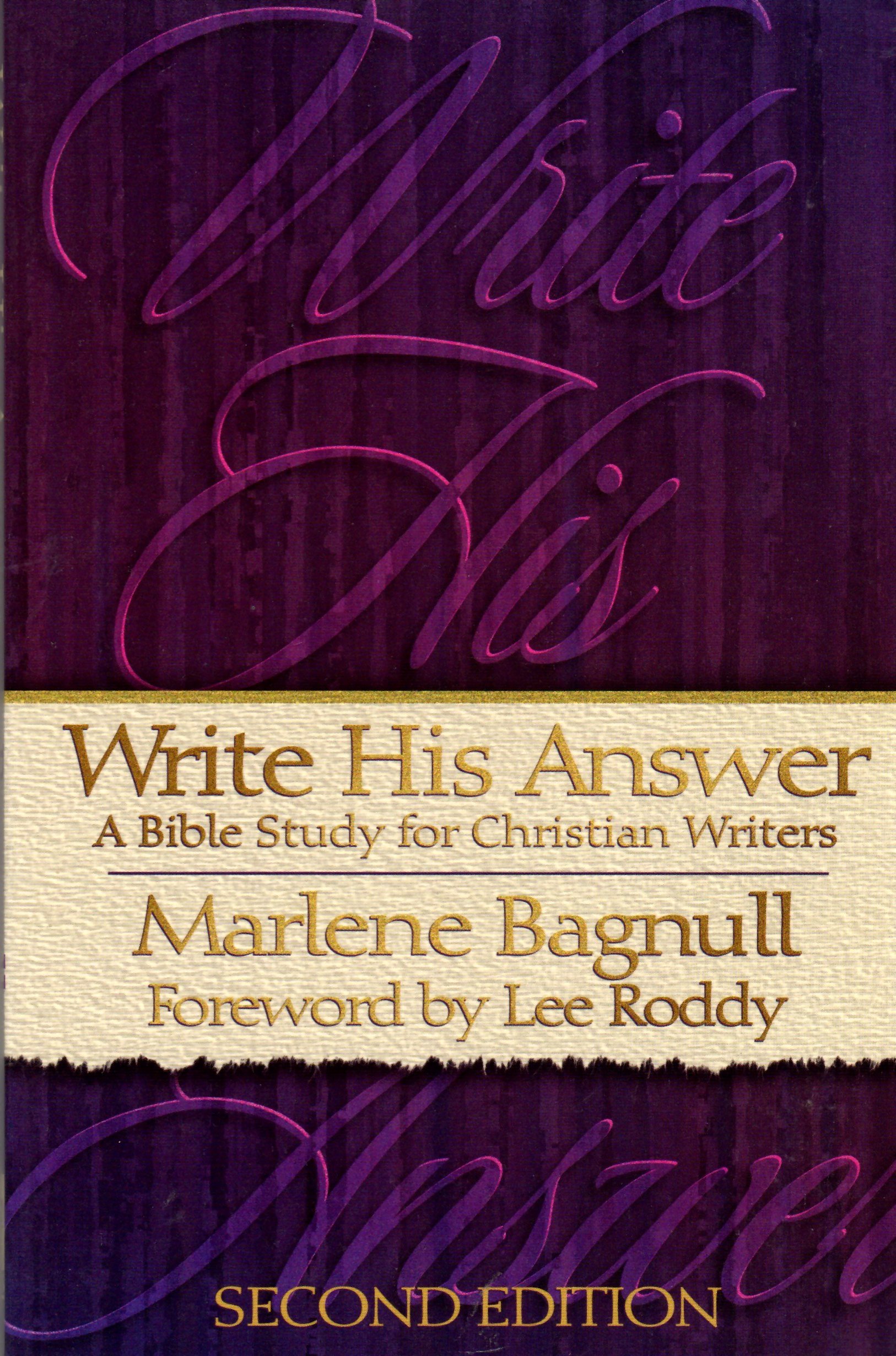
At Saturday’s writers’ conference, Marlene Bagnull was the keynote speaker who opened for the conference.

Image

Marlene shared many wonderful Bible verses that a writer can cling to for encouragement.  She wrote this wonderful book, which I purchased and she autographed, and I can’t wait to dig into it.

She suggested that a writer pray for his/her writing every morning.

She shared how her first book was out six years to forty-two different publishers before it finally was published.  She said, “If you believe God called you to write, don’t give up!”

She said there is a quote: “It takes 1,000 rejection slips to become a professional writer.”  (I’m not sure I have enough time for this.)

She asked, “If you knew Christ was coming back this week, what manuscript would you like to lay at is feet?”

Great things to think about.  The best possible direction — focus on Christ.

If you like this post, be sure to check out Marlene Bagnull’s blog:  http://writehisanswer.wordpress.com/

I have three more posts to cover the writers’ conference, as I will post on each of the authors whose workshops I attended.