Thursday’s Thoughts, Questions, and Comments About Writing

Photo by Thomas Despeyroux on Unsplash

Today I want to talk about dragons. Why do most authors depict dragons as evil, firebreathing creatures?

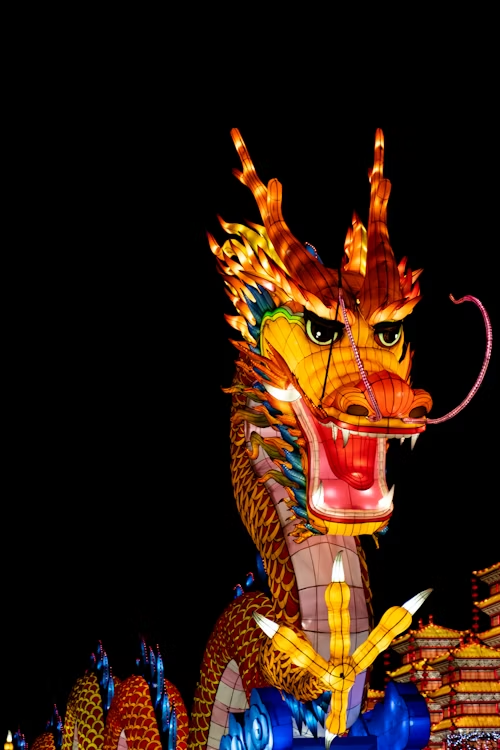
The above photo is a picture, taken by Thomas Despeyroux, of a very large dragon lantern during a Chinese New Year celebration. Dragons are very popular in Chinese mythology and folklore and have been for a very long time. The word dragon comes from the Ancient Greek word “draconta” which means “to watch”. In Chinese, the word for dragon is “loong” or “long”.

The dragon is a positive image in Chinese culture. It symbolizes things like wisdom, prosperity, protection, health, and authority. The dragon heads, in Chinese culture, are depicted as the heads of camels or other animals and are helpful — not dangerous creatures.

The Chinese dragon does not breathe fire, but, instead, breathes clouds or other water-related substances.

(The above information about Chinese dragons was taken from an article here. Click “here” to go to the article to find out much more about the dragons in the Chinese culture.)

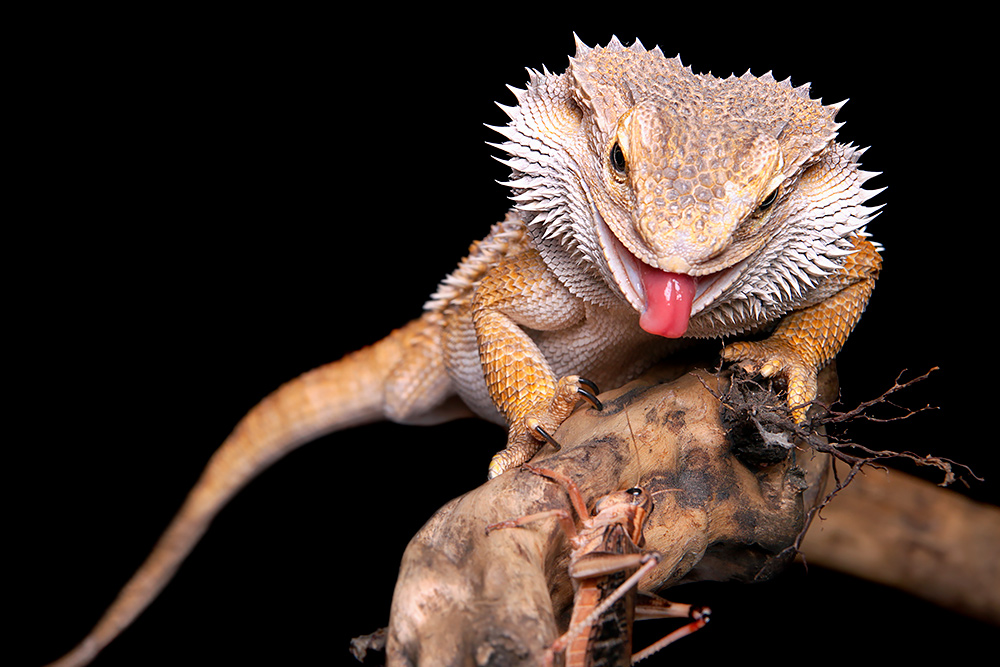
The photo below is a photo of a Bearded Dragon, which is a type of lizard. Many people have Bearded Dragons as pets because they are docile, friendly, and able to adapt to captivity. They do not breathe fire. They enjoy eating leafy vegetables and insects. After reading about them, I think I’d like to have a pet Bearded Dragon. (This information was taken from an article about Bearded Dragons as pets here. Again, click on “here” to read the full article this information was taken from.)

The photo below is a picture of a Komodo Dragon. These dragons, too, are real and still found in certain places in the world–Komodo Island and a few of the Lesser Sunda islands of Indonesia. They can also be found in some zoos. The Komodo Dragon is the largest in the lizard species. It is a member of the Monitor Lizard family. Komodo Dragons do not breathe fire either.

The Komodo Dragon grows to 10 feet in total length and a weight of 300 lbs. Carrion is their main diet item, although they have been known to occasionally attack and kill human beings. They will also wait along game trails to ambush pigs, deer, and cattle. They rarely need to capture live prey since their venomous bite delivers toxins that inhibit blood clotting.

(The above information was taken from an article found here. Click the word “here” to be redirected to the article, to find out more about Komodo Dragons.
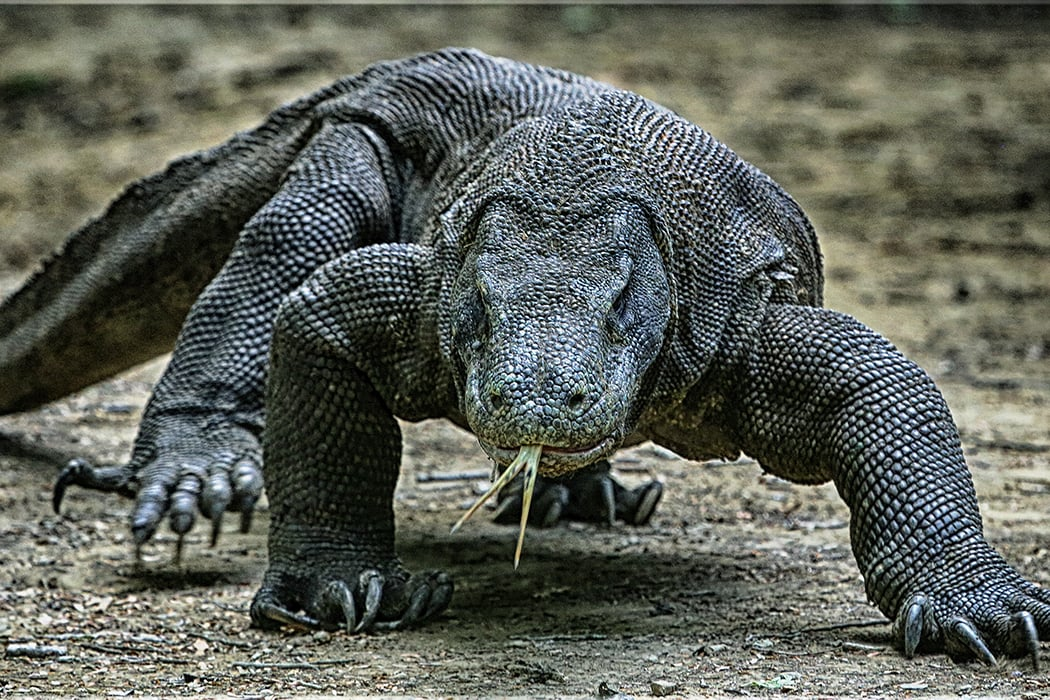
Photo from Adopt a Komodo Dragon | Symbolic Adoptions from WWF

So, of the known dragons that are part of the Chinese Culture and those still living today, none of them breathe fire. The living dragon species were created by God. So, let’s take a moment to look at dragons as one of God’s many creations.

All over the world, people have spun tales of dragons. They have been described as a serpent-like creature. It’s been said they had wings and that they did not have wings. As we’ve already mentioned, it’s been said that many could breathe fire, and many were said to be able to fly.

So, how do we know what’s true and what isn’t? Well, Bodie Hodge and Laura Welch edited and compiled a wonderful book after studying, researching, and separating possible fact from obvious fiction. They published a wonderful book in 2011, called Dragons: Legends and Lore of Dinosaurs, and here is just a little of what they found and shared in the book:

There were reports of so-called “dragons” in many places and cultures. Based on the many descriptions, it is unlikely that the word “dragon” refers to one particular creature. However, they were terrifying to behold, and they were real. Men spoke and wrote extensively about their encounters with these creatures. Cultural artifacts attest to the importance and power that these creatures were attributed with.

Pictures have been found on ancient structures that depict creatures scientists have labeled and named as different types of dinosaurs. Also, the Chinese zodiac, which as a 12-year cycle, has an animal featured for each of the 12 years of the cycle, and every one of the animals can be found living today, except the dragon. It is likely, the Chinese dragon is a depiction of a dinosaur.

The book, Dragons: Legends and Lore of Dinosaurs is a fascinating read, and on page 6 of the book, there is a report, from The Tombstone Epitaph, April 26, 1890 edition of Tombstone, Arizona, of two men who discovered and killed “a strange winged monster” on the Huachuca Desert. There is also a small booklet on the page that gives other “Eyewitness Accounts and Encounters”, one of which is from an essay by John of Damascus, who was a learned scholar and early church leader. John’s essay was translated in the late 1990s, and in it, John describes the difference between dragons as real creatures, named originally by Adam, and the non-real fantastical descriptions of dragons changing their forms that are clearly fiction. John advised people to consult the Biblical text, which reveals the true history and nature of animals from Creation and the qualities that each bear. To read more about John of Damascus and his essay, click here. I also encourage you to purchase and read the fascinating book, Dragons: Legends and Lore of Dinosaurs.

In closing, I would like to encourage all authors and writers who write fantasy and include dragons in your books, to reconsider always making them “evil” creatures.

Thursday’s Thoughts, Questions, & Comments About Writing — Marketing

Photo by Sergiu Vălenaș on Unsplash

In today’s world, whether you publish through a publisher or you self-publish, you will still need to do your own marketing. Now that my first book has been published, I am trying to figure out what marketing strategies work best.

So, what have I done so far?

  1. I have set up an author’s page on Amazon and Goodreads.
  2. I do my best to post here on my blog five days a week, but because I also take my aging mother to medical appointments and have responsibilites in my own household, I don’t always accomplish this goal.
  3. I have a personal page and a professional page on Facebook. If you don’t follow me, please do: my Facebook professional page and my Personal Facebook page. I try to post something on these pages at least once a day, and I try to read and respond to friends’ posts, and to the group posts on the groups I’m a part of. Facebook also has ways to promote posts and I think they have ads available too, but I haven’t tried any of that. I’m just trying to get to know people and connect with readers.
  4. Amazon also has ads, but I haven’t done any of these yet either. There is a cost for ads no matter what website or social media page you’re on. I’ve heard some of the ads are reasonable and worth it, but I’m not ready to try that yet.
  5. I also answer two questions a week on Goodreads and am trying to connect with readers on there as well. Goodreads has some suggestions for authors to do to engage with readers, and they have some marketing tools and suggestions as well. Again, I have not done any of these yet or looked into them in detail.
  6. I’ve been told “word of mouth” is still very effective in selling books, and in the beginning, I have seen that working. I sold a decent amount of books because of that. However, my sales have slowed down, so I need to start looking into and trying some other things. It’s all a process of learning and trial and error.

I have not found much on Barnes & Noble’s website in the way of promoting books, and, honestly, I don’t know if many people buy books from their website. My books been on their website for several weeks now and hasn’t made a single sale. I know Amazon is the place many people go to, not just for books, but for lots of other things. I see their vans all over my town and neighborhood almost on a daily basis, and definitely on a daily basis from October through January.

So, what about you other authors who visit here? What have you done and found effective in selling your books? Please leave a comment in the comments section. I love when we writers/authors can help each other. That’s why I share the posts I share here.

Thursday’s Thoughts, Questions, & Comments About Writing — Writing and Publishing

Photo by Mrika Selimi on Unsplash

Writing and publishing books is much different than it was when I first began dreaming of becoming an author. Like many writers of my generation, I dreamed of writing a fantastic story and submitting it to a publisher, who would love it so much, they’d publish it. I also dreamed that they would arrange book signings for me and get the word out about my book, and get it into bookstores. Yes, I dreamed of seeing a beautiful book cover with my book’s title and my name on the cover on a bookshelf in a cozy bookstore like Barnes & Noble.

My, how times have changed. Now, in the age where technology seems to rule–I mean, the vast majority of the population carries a phone with a computer everywhere they go. They can write or read on their phone. They can purchase books on their phone.

Enter the world of self-publishing. Yes, that is the road I have chosen to travel. “Why?” You might ask. There are several reasons:

  1. I did, at first, at the encouragement of a bestselling author friend, submit a query to an agent. I had high hopes that this agent would be thrilled to represent me and help me get my first novel published. After all, my bestselling author friend was thrilled with the first three chapters she read, and so was her husband, who said I painted the scenes in his mind with the words I used. However, the agent wasn’t as thrilled. Oh, she didn’t turn me down, exactly, but she wanted me to make a lot of changes. You see, I don’t like to read, what is referred to as “formulaic” romance, but that’s what agents and publishers want because that is what they believe sells best because that’s what they’ve seen happen. Now, you may be asking, “what is ‘formulaic’ romance? That simply means that the woman is the main character and the man and woman have to meet within the first few pages. That wasn’t the way my story was written, and still isn’t. However, if I would’ve agreed to make the changes, this agent was willing to work with me because she did like my writing. I was not willing to make those changes.
  2. Traditional publishing takes a long time. After submitting and having your manuscript accepted, it takes a year to eighteen months, sometimes longer, until your book is actually published.
  3. Of course, there are smaller publishing companies as well. I also submitted to one of these. However, they wanted to make lots of changes, beginning with the title I had been using for my book. They also would’ve chosen my cover, and I already had an idea of what I wanted my cover to look like back then, as well.
  4. Finally, my bestselling author friend contacted me after she wrote a book and submitted it to her publisher (a big name publisher). She told me that they had refused to accept her book because her prior book didn’t have the number of sales they had expected. So, she independently published that book and has decided that is the way she will go with future books. She said publishers are getting too picky and, if they are dropping bestselling authors, a new author would really have a battle trying to convince them to take a chance on her.

Now, I will admit, it took me a long time to publish my first book — a little over six years! Why? Because when I started writing my book, I was still homeschooling my sons. I was also still learning what publishers and agents look for, because even though I knew I was going to publish independently, I wanted my book written well. In addition to learning what publishers and agents look for, I studied the writing craft. I also had to do research because I write Historical Christian Romance, and I need to get the history right. In addition to research, learning, and writing, I met consistently with my critique partners and did a lot of editing, as well as a rather large rewrite.

Finally, after a little over six years, I believed my book was ready, and I was ready to release it to the world. Then I hit technology road blocks. I knew absolutely nothing about how to format my book for a paperback book or for an ebook.

Well, praise the Lord, who has a plan for this book! First, he brought a new friend into my life in church. She studied art and computer stuff, and she volunteered to create my cover. Then, God brought another writer into my life — someone who spent her life doing lots of technical and nonfiction writing, and had just been called by God, to write fiction. (She has retired from technical and nonfiction writing, for the most part.) She had already published a fiction book, so she had already figured out how to do the formatting, and how to get it up on Amazon.

Therefore, with my book cover downloaded onto my computer, and with the help of my friend, who knew how to format a book for paperback and ebook, my book was properly formatted, and I was able to publish it through Amazon KDP, which is actually very easy to walk through step by step.

So, my book is available on Amazon, and after it was on Amazon for nearly a month, I figured out how to get it up on Barnes & Noble as well.

Since I now know how to write a good quality story — one that holds the reader’s interest and has them asking if I’m already working on my next book, I don’t anticipate my next book taking nearly as long as this first one did. I am already working on my next book, and though, it might take a year, I’m hoping it won’t, but, ultimately, it’s in God’s hands and it will be published in His time. I just plan to devote as much time as possible working on it because I am building a fan base who are looking forward to it. I hope you’ll be interested in becoming one of them.

No, my first book is not on bookshelves in any bookstore(s), yet. I say “yet” because I haven’t given up that dream, and there are still a couple local bookstores in my area that I plan to approach. That’s part of marketing. I’ll talk about that next week.

Thursday’s Thoughts, Questions, & Comments About Writing

Photo by RetroSupply on Unsplash

Yes, I have decided to make another change to this blog. On Monday, a librarian contacted me about one of my posts in my “Thursday’s Thoughts, Questions, & Comments About Writing” category. Our communication prompted me to do two things:

1) On August 20, 2020, I had written a blog post entitled “Writing Resources” under the “Thursday’s Thoughts, Questions, & Comments About Writing” category. A librarian contacted me about that post. She also suggested another writing resource to add to my list. A fellow librarian, who does a lot of writing, suggested it. Therefore, I added the suggested resource, put that post under the new heading, and create a button for it, at the top of my website, so all writers and authors will be able to find it with ease.

2) This wasn’t the first time I’d been contacted about something I’d posted under that category, and since I’m still writing and am now an author, I decided it would be good to start writing and posting articles in that category again. Therefore, Thursdays are going back to “Thursday’s Thoughts, Questions, & Comments About Writing”, starting today.

If you enjoy the Places, Plants, & Animals posts, don’t worry, they’ll still be here, but I’m moving them to Fridays. That means I will do my best to post here Monday through Friday each week.

So my writing topic today is “the importance of critique partners and editors”. With the ease of independently publishing on Amazon, there are writers who believe they can write, revise, and edit their own book, then publish it without having to have anyone else go over it, especially since the majority of professional editors charge three or four cents per word.

If you write an average length book of 85,000 words, and your editor charges three cents per word, that’s $2,550. If your editor charges four cents per word, it’s $3,400. If you write an average fantasy book of 100,000 words, at four cents a word, that’s $4,000. Let’s face it, new writers can’t afford that, especially if you’re getting ready to publish your very first book. Most writers with a few books under their belt can’t afford that. I happen to know that a lot of writers can’t even afford to write as their full-time job. Many still work outside the home, taking what little time they have to write, when they’re not at their “real” job or doing family things. (And no, I’m not saying writing isn’t a “real” job. Believe me, I know how much work it takes to write and publish a novel.)

So, what can you do? Be sure to find at least three other writers and schedule a time to meet at least twice a month. Share your writing with one another, usually one chapter at a time. That way, each of your chapters is being read and critiqued by four pairs of eyes–yours, and the other three writers’. Doing it this way, the other three writers learn a little bit about who you are. They learn what you write and why you write it. They also learn your writing style and your writing voice. By doing it one chapter at a time from start to finish, they follow your story, making it easier to find continuity issues, as well as errors you repeat.

Most often, at least one person in the group will be good at finding the little errors — things like spelling, punctuation, and grammatical errors. All three should be able to tell you if they think your pacing is too fast or too slow, if your characters all sound the same, if you provide enough description to paint the scenes in your readers’ minds without overdoing it, if you have enough tension to grab and hold your readers’ attention, and all the other big things we want to master.

Listen carefully to what your critique partners say and don’t get defensive. If at least two of them are in agreement about something, you should really think about what they say, and seriously consider making their suggested changes. Of course, you should read over each chapter before giving it to your critique partners to catch as many of your own errors or problems as you can. Remember, the goal is to write a book that is written to the absolute best of your ability.

Another reason it’s so good to have critique partners reading and giving you feedback is because they’ll see the things you do consistently that you need to change, especially words you use too often, too close together. In my first manuscript, I had three words I used too often and/or too close together: looked, smiled, and turned. Because my critique partners pointed those out to me, I was able to change most of them to something stronger and more interesting, which made my novel better and stronger.

This post has gotten longer than I anticipated, so I’ll talk about the importance of a good editor, and how to find one that you can afford, in next week’s post.

Thursday’s Thoughts, Questions, and Comments About Writing

Photo by Maria Stewart on Unsplash

It has come to my attention that I have not addressed script writing for movies or theater (plays). I really don’t know anything about script writing. I have never attempted to write a script for a movie or play, though years ago I wrote a script for a puppet show that was never used.

However, a young lady I mentioned yesterday, Anna, is very interested in script writing and she and her mom found an article online that they felt was helpful to those interested in script writing, and Anna was hoping I would be willing to share it here.

Yes, I am always willing to share anything that may help other writers. So, here is the link to the article that Anna and her mom found helpful: https://www.theaterseatstore.com/blog/writing-for-theater-film. We hope that some of you will find it helpful too.

Thursday’s Thoughts, Questions, and Comments About Writing

I’ve been very busy trying to finish the revisions on my upcoming novel and working my way through finishing a Flash Fiction writing course and Ted Dekker’s Creative Way novel writing course. I’m also helping writers by reading and reviewing their books. Reviews are so important in helping writers to sell their books.

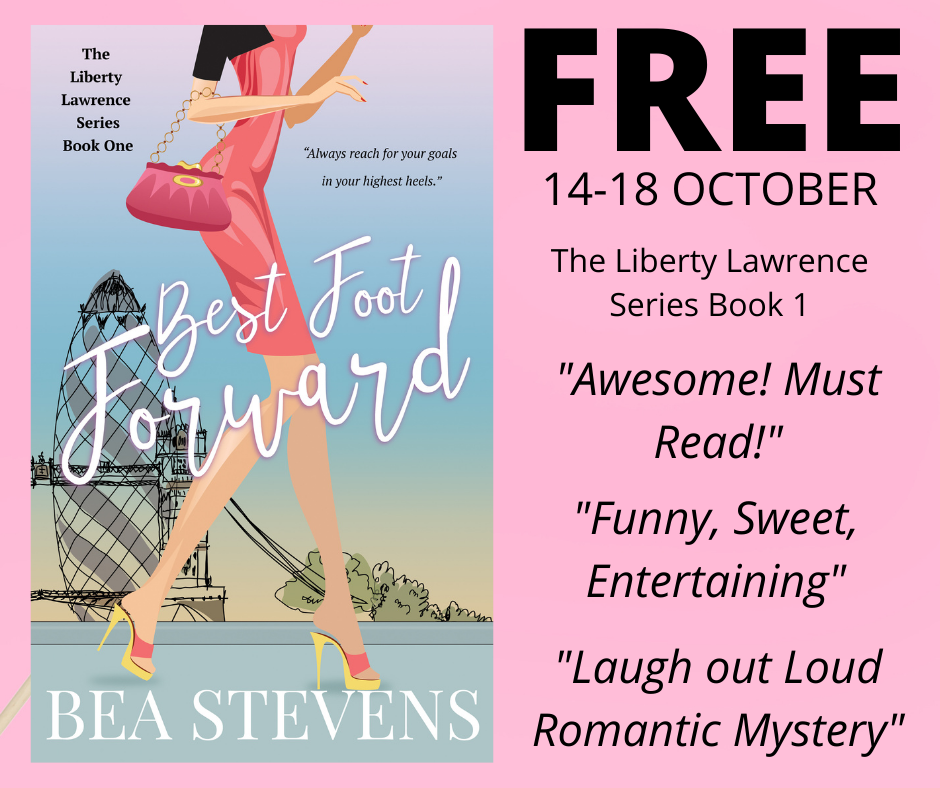
That’s why when Bea Stevens let me know she’s offering her book for Free for the next four days (ebook only), I decided to put this here for all of you to see. My Thursday posts are all about writing and helping other writers. I hope some of you will take advantage of Bea’s Free book, read it, and write a review for her.

Here’s the link for it on Amazon: https://www.amazon.com/Best-Foot-Forward-Liberty-Lawrence-ebook/dp/B07913RZBX/ref=sr_1_1?dchild=1&keywords=Bea+Stevens&qid=1602703293&s=books&sr=1-1

Thursday’s Thoughts, Questions, and Comments About Writing

Just wanted to take a couple minutes today to offer a reminder and ask a couple questions.

Reminder: There is just one week left to share your short story based on the writing prompt that I shared here two weeks ago. One writer shared her short story in the comments section of the post. If you haven’t read it, check it out. It might inspire you to write something. Also, you can post your own in the comments section if it is 500 words or less. If it’s longer than 500 words, you can email it to me and I will post it in a “Special Saturday” post, or, if you have a blog, post it to your blog and put a link to it in the comments section of my post for the writing prompt so that people who read here will still be able to read and like it for you.

Question: I have an idea to help those of you who are interested in being part of an online writing group. I would like to know how many of you there are, so please, if you are seriously interested in an online writing group, let me know in the comments section below: 1) that you are interested, and 2) what exactly are you looking for in a writer’s group?

Question: What do you struggle with most in your writing?

Thursday’s Thoughts, Questions, and Comments About Writing

Writing Resources

I have a friend who is really digging into to organizing her writing things — every story she has started but not completed, her writing notes from conferences and monthly meetings she’s attended as well as from writing books she’s read, and her Pinterest page. She’s also been looking for more resources to learn more about how to write better, and she’s been contacting me with questions. Two of her recent questions have been about what blogs or websites are good writing resources and what books are good resources?

That is how I decided to write this post — to share with all of my readers — the resources I find most helpful and beneficial.

Websites: https://www.almostanauthor.com/ This is a very popular website for writers. It offers tips and advice by genre and craft. It offers support for writers and information on how to to a book proposal, as well as marketing strategies. (I actually write articles for the romance genre and the historical genre on this site — four articles for each of the two genres each year). This website is listed in Writer’s Digest’s Top 100 Websites for Writers almost every year.

https://thewritepractice.com/ This is another great website that offers lots of good tips and advice through tutorials and blog posts for writers.

https://www.writersdigest.com/ This magazine has been around for many, many years and many authors, including bestselling authors have read it and/or written for it. There website offers some great articles and competitions for writers.

https://www.masterclass.com/articles#quiz-0 I have found this website’s article helpful as well. They offer classes, but you can simply search their articles and find some great and helpful information. Simply click the “writing” box and you can scroll through their articles.

https://reedsy.com/ I have also used this website for tips, advice, and helpful articles, etc. for several years. They offer lots of good stuff, including a huge list of writing prompts.

https://www.helpingwritersbecomeauthors.com/ and https://www.goodreads.com/author/show/2975035.K_M_Weiland/blog Both of these websites are also great helps for writers. K.M. Weiland is personable and easy to understand. She has written fiction books as well as books about writing, and she has this website and blog that she uses to offer tips and advice to writers.

https://couponfollow.com/research/money-saving-guide-authors-writers This website suggests resources for authors and writers that are helpful and educational such as, books to purchase, online classes that are free or available for a discount, information on college scholarships for writers, career options, and more!

I’m sure there are others, but these are the ones I find myself returning to over and over again.

Books I have read or used and found quite helpful:

All of the great books by Angela Ackerman and Becca Puglisi. I don’t have all of them yet, but they are all different thesauruses and the ones I own and have used are “The Emotion Thesaurus”, which I have used many times during the writing of my upcoming novel; “The Positive Trait Thesaurus” and “The Negative Trait Thesaurus” — these two I used to create my main characters before starting my story. These were the first three these ladies released. They have since come out with more, and whether you are a pantser, a plotter, or somewhere in between, these books are extremely helpful for writing your stories, no matter what genre you write.

Word Painting by Rebecca McClanahan. I love this book. It is a book that teaches and gives examples of how to write descriptively in a way that paints pictures in your readers’ minds without overdoing it or not writing enough description.

I also find books on any aspect of writing by James Scott Bell to be helpful.

Even though, I haven’t read these two books, they are on my shelf waiting for me to take time for them. They have come highly recommended and I really do want to read them as soon as I can. They are: “Wired for Story” and “Story Genius” by Lisa Cron.

Do you have a favorite writing website or a great book that helps you with your writing that I haven’t listed here? If so, please share in the comments section below.

Thursday’s Thoughts, Questions, and Comments About Writing

Is the woman seated upset by what the older woman is looking at?
What are these women doing?
Who are these women?
Where do they live?
What is the time period?
What has happened?
Is the seated woman related to the older woman, and if so, how?
Again, short writings can be posted directly in the comment section below. If your story is over 500 words, however, please send them to my email address and I will create a special post for those stories.
Please either add your short stories to the comments below or send your longer stories to me at: cre8tiveme07@gmail.com no later than Thursday, August 27th — that gives you two weeks to study the picture, consider the questions, and create your story. Good luck!

Thursday’s Thoughts, Questions, and Comments About Writing

rawpixel-315198-unsplash

rawpixel-315198-unsplash.jpg

Hello and thank you to those of you who responded to last week’s little survey in regard to writing and critique groups. The survey consisted of four questions and I will go through them one at a time, sharing both the responses of those who left their answers in the comments last week, as well as my own personal experiences.

Q:  Are you part of a writer’s group or critique group?

A:  Mary shared that she is not part of either a writer’s group or a critique group. She also shared that she doesn’t have a lot of time to commit to a group regularly. Her available time would be sporadic.

Kayla also shared that she is not part of a specific writer’s group or critique group. However, she is part of a writer’s chat-type group.

I have been a part of a writing group for seven years. I also participated in a writing group for three or four years. I am also part of several writing groups, though not active in some of them. I have been a part of several different critique groups as well, but am currently part of only one small critique group.

Q:  Does your group meet in person or strictly online.

A:  This question didn’t apply to Mary, and it didn’t really apply to Kayla either, although Kayla did share that if she were part of a group, online would work best for her.

My current writer’s group and critique group are in person groups, although the writer’s group hasn’t met in person since Covid-19 began.

I have also been part of an international group that was online, except for an annual in person conference. I was a part of that group for three or four years, and it definitely benefitted me to some degree. I am also part of several online writing groups on Facebook, and I am part of the same online chat-type group as Kayla.

Q:  If you’re not part of a writer’s group, would you like to be?

A:  Mary said she thinks she’d like to be, and Kayla said she would like to be.

Q:  How do you benefit from participating in a writer’s group?

A:  Mary thought it would be helpful to find out if her writing is interesting to other people. She also shared that she knows she tends to be more “wordy” than current guidelines suggest, and she shared that she doesn’t always have a lot of confidence in her skills.

In my experience over the past seven years, I have found some writing groups and critique groups very helpful, and I have found that some writing groups and critique groups were not helpful. Some were even harmful.

How could a writing group or critique group be harmful? The groups that I attended that fall under this category, I visited just once and never went back because they were very unkind with their critiques of other writers’ works. They were quite critical and stated things in an unkind way instead of being kind, helpful, and offering constructive criticism. Had I attended any of these groups years before I did, I may have walked away thinking I couldn’t possibly be a writer and may have stopped writing. Thankfully, I had learned some things before attending such a group, and walked away feeling sorry for those in the group because I felt that they were missing out on something.

Another group that wasn’t helpful was a group of people who wrote “for themselves”. Although some of them said they would like to get published, they criticized “considering their audience” as they wrote, or following “any” rules at all in their writing.

I have found the Facebook groups very helpful in the past. However, since Facebook has become a catalyst for people to criticize one another, be unkind toward others, and go on and on about politics or Covid-19, I avoid Facebook for the most part. Not to mention, I have become quite busy with my writing endeavors, and I found it beneficial to cut down on the number of groups I participate in. I decided to narrow it down to the groups I find most beneficial and least time-consuming for me.

I also want to mention one type of critique group that I have not found as helpful as I would like, and that is a critique group that meets only once a month and doesn’t consist of the same people each month. This group also doesn’t share progressive pieces, like sharing your novel chapter by chapter, because it would take too long, since they only meet once a month. This caused some people to struggle with focusing on the piece being shared because it may not be the next one in order from the last one they read. They couldn’t seem to simply focus on the piece before them without wanting to know what happened “before”.

So, what kinds of writing and critique groups do I find helpful?

I am part of a writing group that meets once a month and has a speaker each month that teaches something about writing, publishing, or marketing. They also have an annual one-day conference where there are hour long seminars taught on writing, publishing, or marketing, and you can have one-on-one meetings with editors, published authors, or publishers, and, occasionally, maybe, an agent. I have found this group helpful and beneficial. I have made valuable connections and dear friends through this group.

I am also part of a writer’s group that I started with a small group of women that I was friends with, when I learned that they all had a strong interest in writing. We decided to have a very unique writing group, and it works very well for us. We meet, (or at least we did before Covid-19), once a week either at a coffee shop or one of the ladies’ homes. We spend two hours together brainstorming, asking each other for tips or advice, and just writing. We even had all nighters from time to time, where we stayed up all night on a Friday night engaging in these same activities. (Now, we’ve all gotten to a place where we can’t stay awake all night anymore, so we plan to implement the same thing as all-day.)

The critique group that I found that works best for me, and I’ve heard other writers speak highly of similar critique groups, consists of just me and two other ladies. We have been getting together, weekly for the first summer or year, then biweekly since, and we share our chapters to our novels, one after the other. I find this so helpful and effective because we really get to know each other’s writing style, voice, and goals, and this knowledge makes the feedback I get from these ladies incredibly helpful in my editing and revising process. This will seriously cut down on the cost of a professional edit before I publish.

With all of that said, I really only participate in the chat-type online group now because there’s no pressure to engage at specific times. We have members from different parts of the world, therefore we are not all in the same time zone. So the way this works, we enter the private meeting room and talk with whoever’s there when we are and we talk about writing, publishing, marketing, how to design a book cover, etc. In addition, we share things about ourselves and our lives. We encourage one another not just in our writing journeys, but in our life experiences without pressure or judgement.

So, as you can see, I regularly participate in three writer’s groups, each different from the others, and one critique group. The benefits I receive from these groups are: encouragement, support, ideas, advice on improving my writing, and interacting with people who are kind, who care about me, and who become friends.

Mary and Kayla, I hope you see this post and read it, and I hope others who would like to become part of a writer’s group, but don’t know how to find one or don’t have access to one in your own area, also read this. I am interested in helping writers like you to be able to participate in a group that would be valuable to you. I am trying to figure out how best to do that. Please keep reading my Thursday posts because as I work out the details, I hope to create a group for you, and when I know how it will all work, I will post here to explain it and offer it to you.

Writing may seem like a very solitary activity, but no one likes to be in something alone, and I have found many writers to be helpful, caring, and encouraging, and that is what I want to provide for those of you who are looking for that. That’s the purpose of these Thursday posts as well.